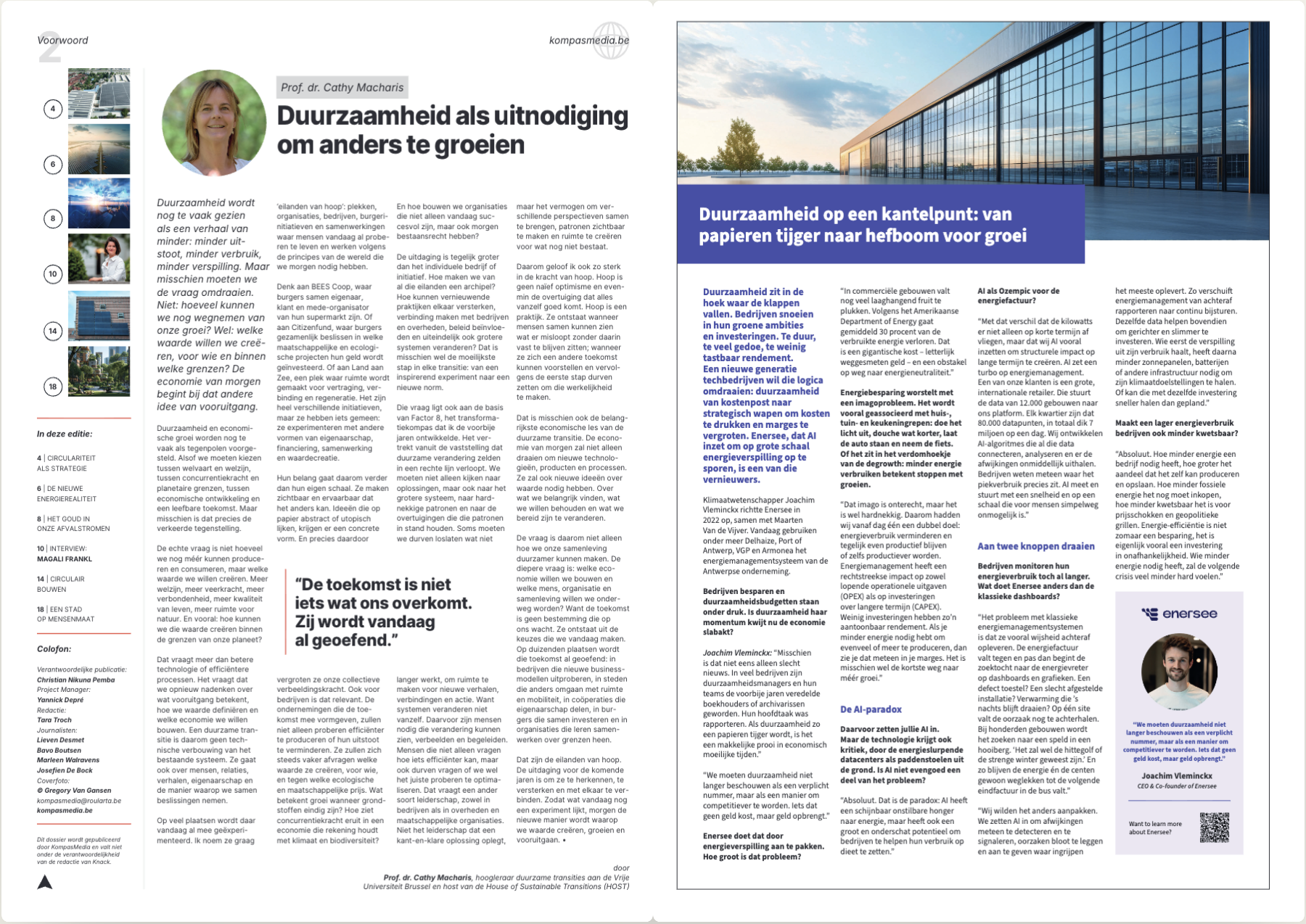
Sustainability is taking the hits. Companies are cutting back on their green ambitions and investments: too expensive, too much hassle, too little tangible return. A new generation of tech companies wants to turn that logic around, transforming sustainability from a cost item into a strategic weapon for cutting costs and growing margins. Enersee, which uses AI to detect energy waste at scale, is one of those innovators.
Climate scientist Joachim Vleminckx founded Enersee in 2022 together with Maarten Van de Vijver. Today, Delhaize, Port of Antwerp, VGP and Armonea are among the companies using the Antwerp-based firm's energy management system.
Companies are cutting costs and sustainability budgets are under pressure. Has sustainability lost its momentum now that the economy is sluggish?
Joachim Vleminckx: "Maybe that's not entirely bad news. In many companies, sustainability managers and their teams have become glorified bookkeepers or archivists in recent years. Their main task was reporting. When sustainability becomes a paper tiger like that, it's easy prey in tough economic times."
"We need to stop seeing sustainability as a mandatory exercise and start seeing it as a way to become more competitive. Something that doesn't cost money, but makes money."
Enersee does that by tackling energy waste. How big is that problem?
There's still a lot of low-hanging fruit in commercial buildings. According to the US Department of Energy, an average of 30 percent of the energy consumed is wasted. That's a huge cost, literally money thrown away, and an obstacle on the road to energy neutrality."
Energy saving has an image problem. It's mainly associated with everyday household measures: switch off the lights, take shorter showers, leave the car at home and take the bike. Or it gets lumped in with degrowth: using less energy means you stop growing.
"That image is undeserved, but it's persistent. That's why, from day one, we had a dual goal: reduce energy consumption while staying just as productive, or even becoming more productive. Energy management has a direct impact on both ongoing operating expenses (OPEX) and longer-term investments (CAPEX). Few investments have such a demonstrable return. If you need less energy to produce the same or more, you see it immediately in your margins. It may well be the shortest route to more growth."
The AI Paradox
You use AI to do that. But the technology is also criticized, with energy-guzzling data centers popping up like mushrooms. Isn't AI just as much part of the problem?
"Absolutely. That's the paradox: AI has a seemingly insatiable appetite for energy, but it also has great and underestimated potential to help companies put their consumption on a diet."
AI as Ozempic for the energy bill?
"With the difference that the kilowatts don't just come off in the short term; we mainly use AI to create structural, long-term impact. AI puts energy management into overdrive. One of our clients is a large international retailer that sends data from 12,000 buildings to our platform. That's 80,000 data points every fifteen minutes, well over 7 million a day. We develop AI algorithms that connect and analyze all that data and immediately pick out the anomalies. Companies know right away exactly where their peak consumption is. AI measures and steers at a speed and scale that's simply impossible for humans."
Turning Two Dials
Companies have been monitoring their energy consumption for a long time. What does Enersee do differently from traditional dashboards?
"The problem with traditional energy management systems is that they mainly deliver hindsight. The energy bill comes in higher than expected, and only then does the search for the energy hog begin, across dashboards and charts. A faulty device? A poorly calibrated installation? Heating that keeps running at night? At a single site, you can still track down the cause. Across hundreds of buildings, it's like looking for a needle in a haystack. 'It must have been the heatwave or the harsh winter.' And so energy and money just keep leaking away until the next final bill lands in the mailbox."
"We wanted to take a different approach. We use AI to detect and flag anomalies immediately, uncover their causes and show where intervention will pay off most. That shifts energy management from after-the-fact reporting to continuous adjustment. The same data also helps companies invest in a more targeted and smarter way. If you first remove the waste from your consumption, you'll then need fewer solar panels, batteries or other infrastructure to reach your climate goals. Or you can reach them faster than planned with the same investment."
Does lower energy consumption also make companies less vulnerable?
"Absolutely. The less energy a company needs, the greater the share it can produce and store itself. The less fossil energy it still has to buy, the less vulnerable it is to price shocks and geopolitical whims. Energy efficiency isn't just a saving; above all, it's really an investment in independence. Those who need less energy will feel the next crisis far less severely."
Written by
and