Energy management tends to work, right up until it doesn’t. For many organizations, the breaking point arrives somewhere here: a growing portfolio, a few more data sources, tighter reporting requirements. Suddenly, tasks that once felt manageable start slipping through the cracks.
Traditional energy management systems (EMS) tools were built for a world of smaller portfolios, stable operations, and periodic reviews. And today, that scenario is no longer the reality for most organizations. Now we’re dealing with higher energy prices, tighter regulations, and portfolios that span across regions or countries. Traditional EMS start to show their limits.
A tool that works for 10 buildings will rarely deliver the same quality on 100 buildings. Some are now turning to Virtual Energy Managers, tools that switch from manual oversight to continuous, automated decision-making. But why is that shift necessary? And why can’t traditional EMS keep up the pace? We’ll help you understand the answers throughout this article.
What are traditional EMS tools?
When people talk about EMS tools, they’re usually referring to a broad category of software designed to monitor, report on, and sometimes analyse energy consumption across buildings or assets.
In practice, traditional EMS tools include:
- Dashboards that visualize meter and BMS data.
- Reporting tools focused on compliance and audits.
- Rule-based alerting systems.
- Spreadsheet-driven energy tracking layered on top of utilities or BMS.
These tools aren’t inherently bad. So, what’s the problem then? It’s the fact that most were designed to answer a specific question: ‘How much energy are we using?’ But at scale, that question is no longer enough.
Because when you notice that energy consumption is too big, you need to understand why. Where does the problem come from? Which building, which exact tool?
As portfolios grow, energy teams need help deciding where and when to act, and what actually matters. And traditional EMS tools rarely provide these answers.
Common types of traditional EMS tools (and examples)
EMS tools as a term doesn’t refer to a single product type, but to a group of tools that share a similar operating model. Most focus on monitoring, reporting, and rule-based alerts, with limited automation or decision support.
Common categories include:
- BMS-linked EMS platforms, often extensions of building automation systems, used to monitor HVAC, lighting, and equipment performance. Examples include legacy EMS modules from vendors like Schneider Electric, Siemens, and Honeywell.
- Energy monitoring and reporting tools, designed primarily for tracking consumption, generating reports, and supporting audits or compliance.
- Rule-based anomaly detection tools, which rely on predefined thresholds or simple comparisons to flag issues. While useful for basic monitoring, they tend to generate large volumes of alerts without explaining root causes or prioritizing them by impact.
Why traditional EMS tools don’t scale
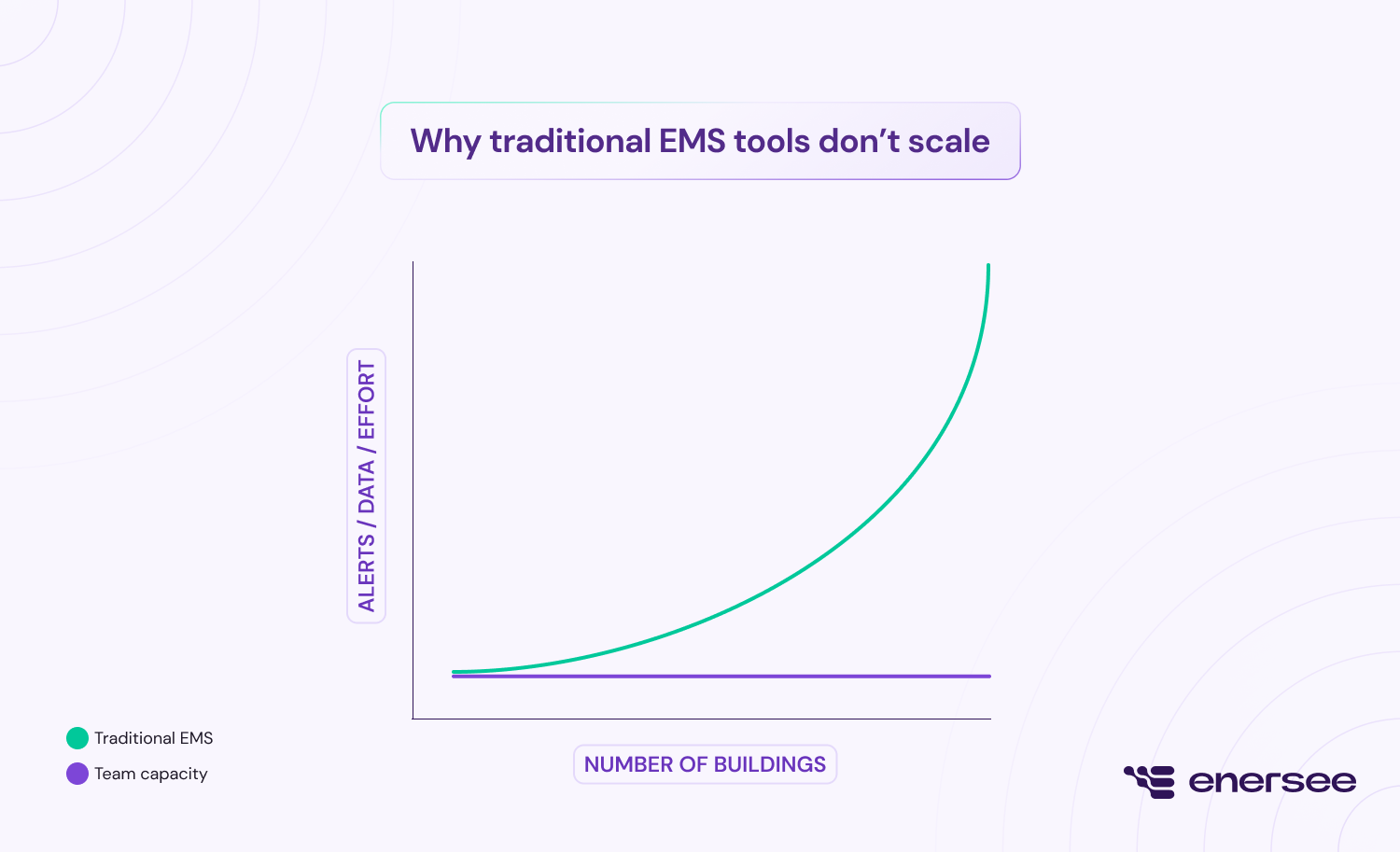
At the core of the issue is a mismatch between what traditional EMS tools and equipment do and what large, complex organizations actually need.
Monitoring instead of decision-making
Most EMS tools software focuses on data collection and visualization. Meters feed dashboards, dashboards generate alerts, and teams need to interpret what all of it means. To say that’s ineffective would be an understatement.
Charts don’t tell a story unless there are real insights backing them up. In industry surveys, energy managers confirm this gap. Verifying savings and identifying new efficiency opportunities remain top challenges, suggesting that many tools don’t make it easy to pinpoint savings or prove the impact of projects.
EMS reporting tools add workload instead of removing it
Reporting is without a doubt one of the biggest pain points at scale. Data exports, spreadsheet manipulation, manual checks, and audit preparation consume a disproportionate amount of time.
Recent studies show us that automation could save both time and energy with just a few simple changes. For instance, a study of monitoring-based commissioning conducted by the US Department of Energy found a median 7% annual energy savings from buildings that used automated EMS software.
EMS tools can have integration issues
Large portfolios rely on a mix of BMS, meters, IoT devices, and utility feeds. Traditional EMS often struggle to unify these sources reliably. As a result, teams find themselves facing gaps, inconsistent data quality, and manual corrections. The more sites you have, the harder all this becomes to handle.
Detection is slow and expensive

One of the biggest problems with traditional EMS: most of them operate in hindsight, generating reports or alarms well after an event has occurred. They rely on periodic reviews or static thresholds. The problem? A recent study showed 9% of organizations had never undergone an energy audit.
The culprit is a lack of knowledge and means to conduct a proper energy audit at large scale. More buildings mean more data, more alerts, more spreadsheets, and more reliance on scarce expertise. The system slowly but surely becomes unmanageable.
What actually scales: automated and AI-driven EMS

Scaling energy management requires a different operating model.
Instead of the usual static rules and periodic reviews, automated and AI-driven EMS platforms rely on continuous analysis. They learn how buildings typically behave, taking into account historical patterns, building characteristics, and external factors like weather or operating hours.
When performance deviates, they don’t just send you an alert. They add context. How significant is the deviation? How much is it likely to cost in damages? Does it need attention now, or can it wait? That helps you prioritize and makes scaling manageable.
This is where the concept of a Virtual Energy Manager comes into play. These are modern, automated EMS platforms that act as an always-on layer of intelligence, reducing manual oversight and helping teams focus on pressing issues.
From “best EMS tools” to the right EMS model
You want to find the best EMS tools for your organization. The problem is, these searches often assume the answer lies in feature comparisons or vendor shortlists. In reality, the issue goes deeper.
A European “State of Energy Management” survey in 2021 found a “high percentage of respondents feel their energy management strategies are not efficient enough”, citing challenges like starting new efficiency projects, verifying savings, and finding new savings opportunities.
That’s because the question isn’t which EMS tool has the most dashboards or reports, but whether the underlying model can handle complexity without overwhelming you. A traditional EMS tool will go for visibility. Automated systems prioritize decision-making.
At scale, that distinction matters more than individual features. Tools that rely on manual interpretation, static thresholds, or spreadsheet-based workflows will always struggle when your portfolio grows.
The alternative? A tool that acts as your Virtual Energy Manager. For instance, Enersee is designed with automation, prioritization, and decision-making in mind. It won’t overload you with dozens of alerts without context. Instead, it will help you pinpoint exactly where the issue is coming from, and guide you in fixing it.
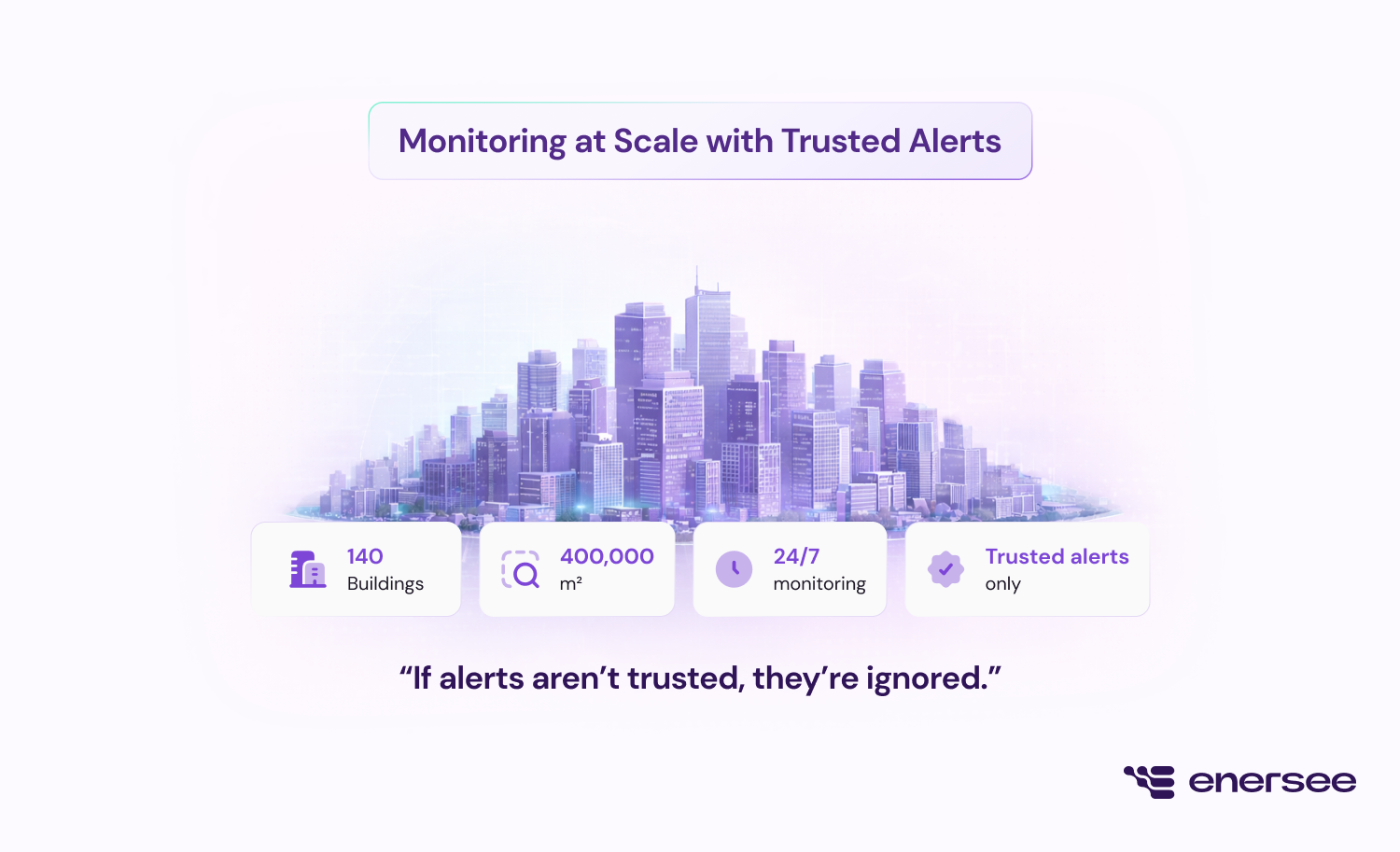
At VDAB, a public agency managing 140 buildings across 400,000 m², this shift removed the need for constant dashboard monitoring altogether. As Alexander Daenen, Head of Environment and Energy, explains: “If alerts aren’t trusted, they’re ignored. What changed things for us was not more alerts, but relevant ones.”
With Enersee acting as a 24/7 Virtual Energy Manager, the team gained confidence that deviations would be flagged only when they truly required action, even outside working hours.
Choosing the right EMS model is less about software selection and more about aligning tools with how energy management actually works in large organizations.
If your organization manages a large, distributed portfolio, moving beyond traditional EMS tools is the next logical step and the key that will help you build an energy management approach that can keep up with your needs in the long term.
Written by
Joachim
and