The way we approached energy management until recently is failing. Not because organizations don’t care about efficiency. Because the tools designed to support it aren’t good enough.
For decades, managing energy meant periodic audits, static dashboards, and manual analysis performed by overstretched teams. The results weren’t necessarily bad. Except that many times, data arrived late and insights required expert interpretation.
Add to that the fact that problems were often spotted weeks or months after they appeared on the bill, and you were in for a disaster.
For a while, those systems were manageable. Today, rising energy prices, tighter regulations, and portfolio-scale operations have made that approach unsustainable. The solution? A Virtual Energy Manager (VEM).
What exactly is that? It’s software, but it’s also a fundamental change in how people approach energy performance, helping switch to a model where monitoring and data interpretation happen continuously, automatically, and at scale.
What is a Virtual Energy Manager?
Put simply, a Virtual Energy Manager is an always-on, automated energy management system that continuously monitors energy performance across buildings. It detects inefficiencies as they happen, so you don’t have to wait until the problems reflect on your bill. Plus, it can translate raw data into prioritized, actionable insights.
Is it the same thing as an energy management system (EMS)? Not exactly. A traditional EMS relies on static thresholds and manual review. In contrast, an automated energy manager learns how each building actually behaves. It establishes dynamic baselines, identifies deviations in real time, and evaluates their operations and financial impact.
In practice, a Virtual Energy Manager:
- Monitors energy consumption 24/7 across entire portfolios.
- Automatically detects anomalies and inefficiencies.
- Prioritizes issues based on cost, urgency, and compliance risk.
- Tracks progress and verifies whether actions actually deliver savings.
The goal is simple: remove the need for constant human monitoring while improving decision quality.
Virtual Energy Manager vs Legacy EMS
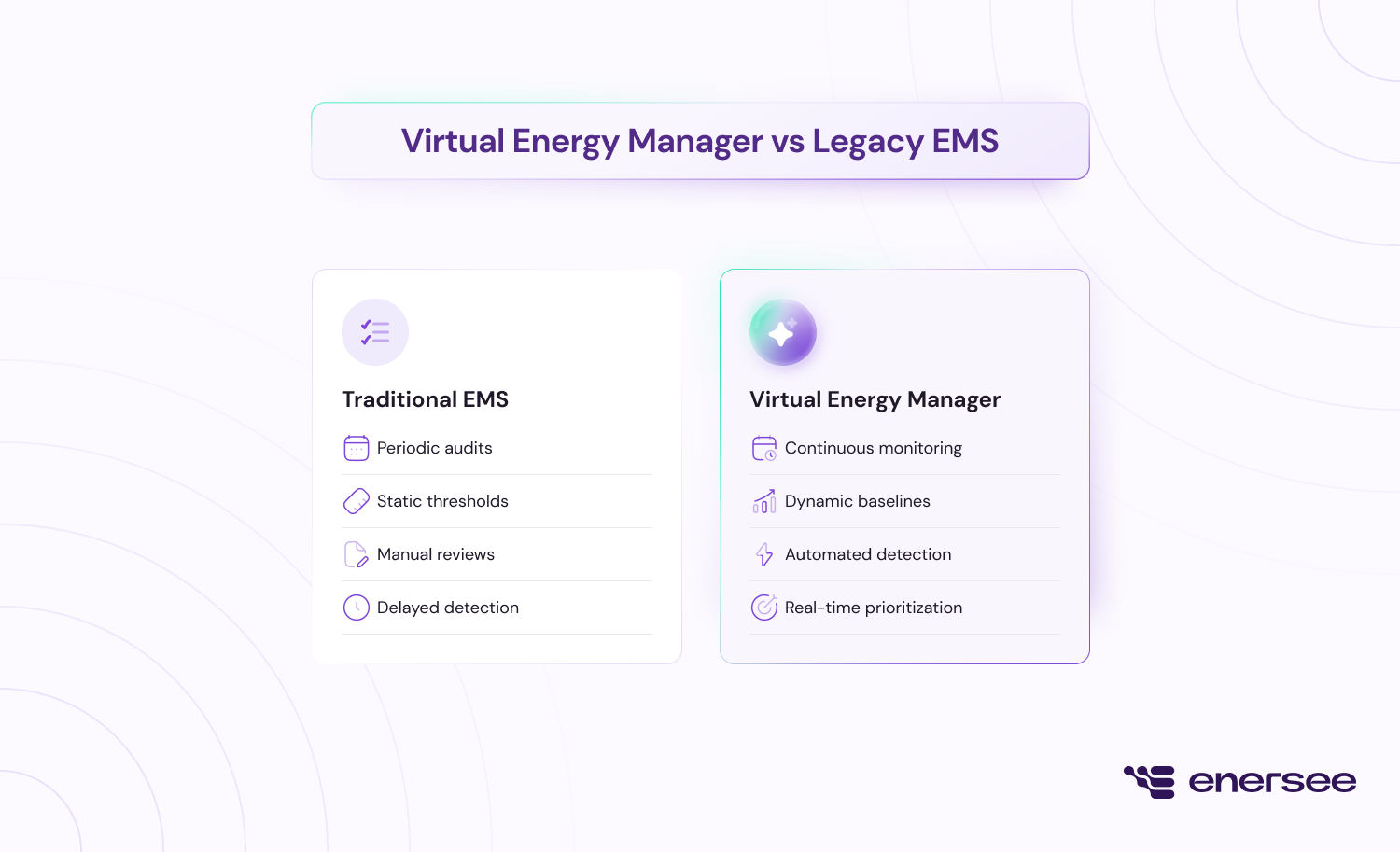
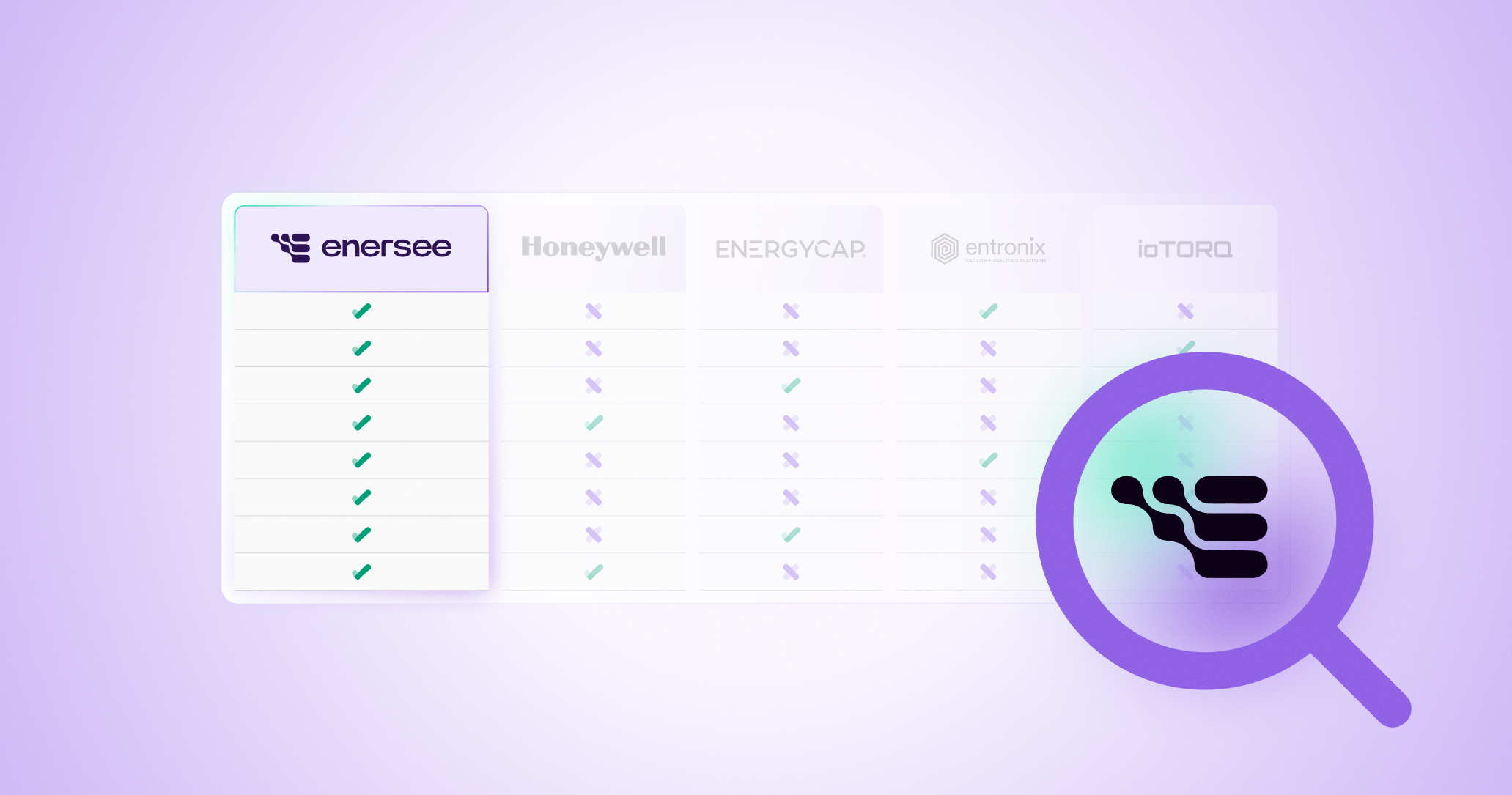
Still not convinced a Virtual Energy Manager is more helpful than a traditional energy management system? Let’s take a look at how they compare.
The Limitations of Traditional EMS
A 2021 survey of energy professionals found that while 55% had an EMS in place, nearly 30% still relied on giant Excel spreadsheets instead of specialized tools.
Let’s be honest. Nobody likes working with such spreadsheets. So, the fact that so many still do is a clear indicator people aren’t happy with their traditional EMS, and that they lack certain features organizations need.
That’s because most traditional EMS platforms were designed mainly as monitoring tools. They collect meter data, visualize trends, and trigger alerts when predefined thresholds are crossed. On paper, that can sound sufficient. In reality, it’s a different story.
To understand just how different, it’s enough to look at some numbers. Commercial buildings, for instance, waste around 30% energy due to control problems and undetected faults. Precisely the kind of waste that a well-utilized, continuous EMS should catch, but a neglected or periodic approach often misses.
Another problem is that teams often get flooded with alerts that lack context. Many of these alerts are trivial, seasonal, or operationally irrelevant, while costly issues remain hidden.
Detection can also be extremely slow. By the time you identify an issue through periodic review or audits, the financial impact has already accumulated. Not to mention that a 2024 study found only 9% of businesses had ever undergone an energy audit at all.
In large portfolios, inefficiencies can persist for weeks or months before anyone notices. The result is a familiar frustration: lots of data, very little clarity.
How Virtual Energy Managers Change the Model
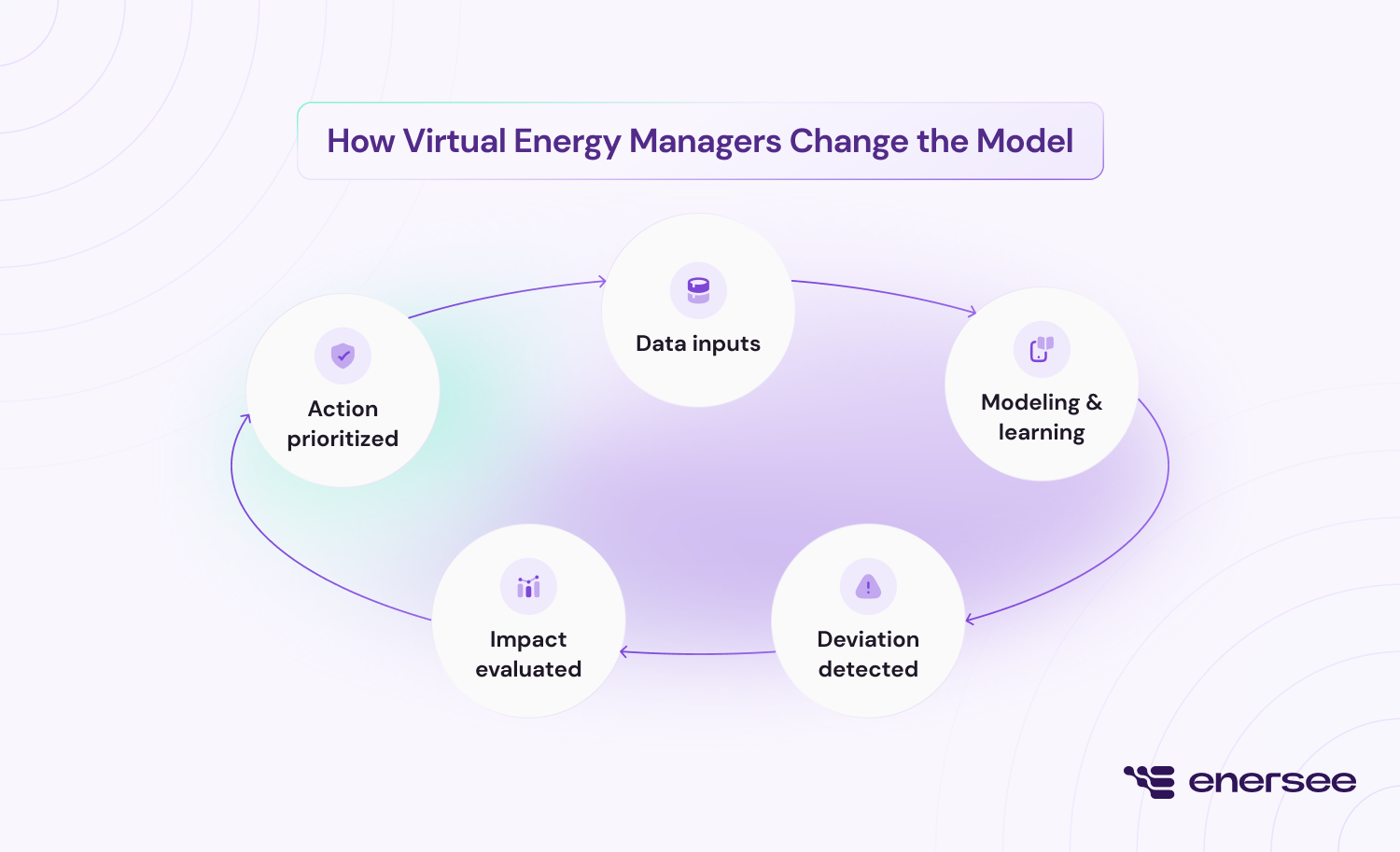
A VEM doesn’t rely on fixed rules like a legacy EMS would. Instead, it continuously models expected behavior based on historical data, building characteristics, and even factors like weather. When something doesn’t work as usual, the system evaluates the size, cost, and urgency of the issue.
Rather than asking energy teams to hunt for problems, a VEM brings the most impactful ones directly to the surface.
This shift has driven demand for automated energy management solutions that can scale across hundreds or thousands of buildings.
Enersee’s Virtual Energy Manager
Enersee is not your average EMS. It belongs to a new class of high-end automated energy management systems built for complex, large-scale portfolios and functions as your 24/7 Virtual Energy Manager.
At its core, Enersee combines deep energy expertise with an AI-native platform designed for real-world operational complexity.
Always-on Intelligence, Not Periodic Analysis
Enersee continuously connects to data from meters, BMS, utilities, and other systems through its dedicated integration backbone. Data is cleaned, validated, and processed automatically, ensuring models are built on reliable inputs rather than assumptions.
From there, Enersee’s AI engine learns how each building and installation behaves under normal conditions. This allows it to detect inefficiencies that static rules and traditional anomaly detection would likely miss.
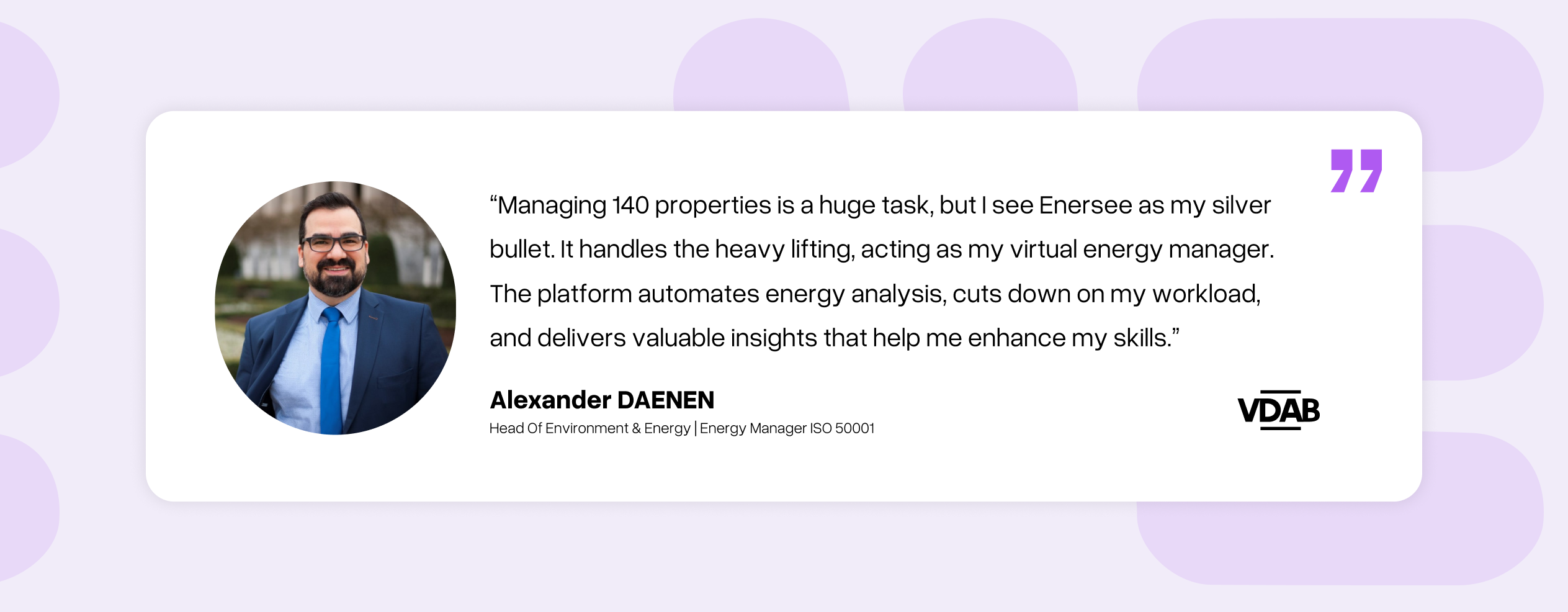
So, what does automated energy management for retailers look like in practice? At VDAB, a public agency managing 140 buildings across 500,000 m2, Enersee acts as a 24/7 Virtual Energy Manager, continuously monitoring energy use at 15-minute intervals.
The team replaced static thresholds with context-aware detection, eliminating false alarms and gaining real-time visibility into deviations that previously went unnoticed. That allowed a small central team to maintain continuous ISO 50001 control without constant dashboard monitoring or manual triage.
From Detection to Prioritization
One of the biggest problems with legacy EMS is that they stop at detection. Sadly, detection alone is not enough. These systems flood teams with alerts but can’t explain what’s actually wrong or what to do next. Enersee brings clarity to the mix.
It evaluates every detected anomaly through a financial and operational lens and ranks issues based on:
- Estimated cost impact.
- Operational urgency.
- Regulatory or compliance relevance.
This means teams can focus their time where it actually matters, and a minor deviation no longer competes for attention with a fault costing tens of thousands of euros.
Automated Energy Audits and Compliance Support
If you’re not a fan of spreadsheets and manual audits, you’ll be happy to learn that Enersee helps you say goodbye to them as well, replacing them with continuous analysis.
Instead of performing audits once every few years, organizations can run automated energy audits all the time. The platform identifies required measures linked to regulations such as BACS and EPC-NR, flags subsidy opportunities, and tracks progress.
In healthcare, retail, and logistics portfolios, customers report spending significantly less time on audits and reporting, while gaining clearer visibility across their entire building stock.
Proven ROI at Portfolio Scale
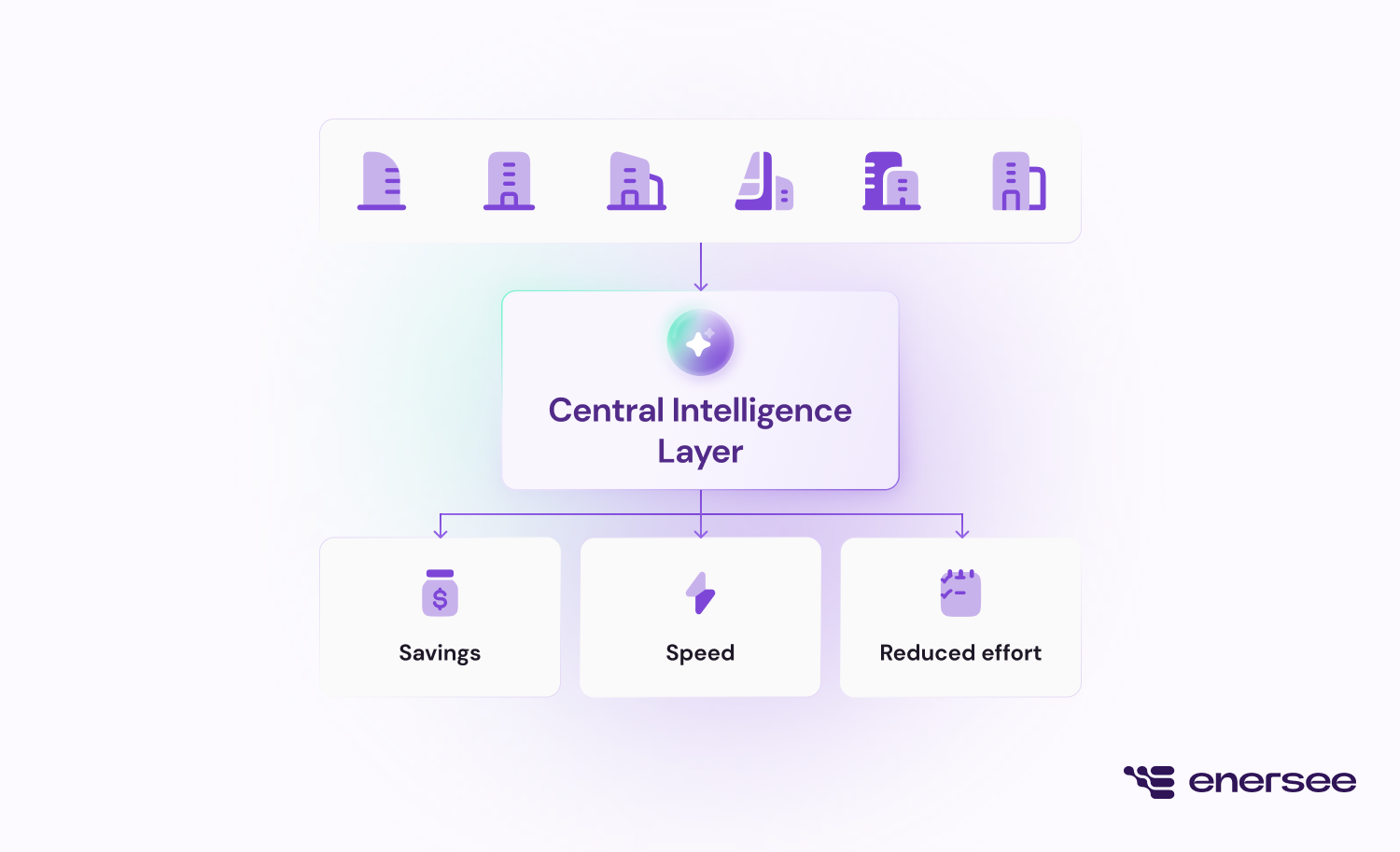
The impact of a Virtual Energy Manager becomes most visible at scale.
In a portfolio of 1,000 retail stores, Enersee’s Operations module alone unlocked approximately €3.5 million in annual savings, compared to under €200,000 identified through traditional anomaly detection methods. Resolution times dropped from weeks to days, preventing losses before they escalated.
Beyond operational savings, Enersee also improves capital allocation by identifying which efficiency projects deliver the highest return, and which underperform, using standardized, real-time verification.
The bottom line? Upgrading from a traditional EMS to a Virtual Energy Manager like Enersee will convert energy management from a tedious box-ticking exercise into a strategic, cost-saving, and carbon-saving asset.
Written by
Joachim
and