ISO 50001 is an international standard meant to help organizations use energy more efficiently. It’s voluntary, though energy efficiency in and of itself is not. Under the European Energy Efficiency Directive (EED), organizations must systematically assess their energy use to identify opportunities and prove they’re making measurable improvements, with deadlines starting in October 2026.
For many companies, though, compliance with the EED is anything but easy. Data often lives across multiple systems, energy audits consume a lot of time, and reporting obligations keep expanding. Something that looks beneficial and straightforward on paper can be a real administrative burden.
That’s why many organizations are rethinking their approach. Instead of treating EED compliance like a series of individual tasks that circulate on repeat, they’re adopting ISO 50001. A structured energy management framework, this standard goes beyond compliance and turns energy efficiency into a manageable process.
So what is ISO 50001, how does it help with EED compliance, and how to implement it? We’ll answer all these questions below.
What are ISO 50001 and EED — how are they connected?

ISO 50001 is an international standard for establishing, implementing, maintaining, and improving an energy management system (EMS). It can be applied to organizations of any size and in any sector, and you can integrate it with other management systems like ISO 9001 or ISO 14001.
So, how does ISO 50001 work? You might expect it to require specific technologies or efficiency measures. The reality is more nuanced. Instead of doing that, ISO 50001 provides a structured framework for how organizations can manage energy across their operations.
The standard follows the well-known Plan-Do-Check-Act (PDCA) cycle.
- Plan: understand energy use, define baselines, set objectives.
- Do: implement improvement actions.
- Check: monitor performance and measure results.
- Act: adjust strategies and improve continuously.
This approach perfectly matches the intent of the EED. On one hand, the directive defines what organizations must do, such as performing energy audits, or proving energy savings. On the other hand, ISO 50001 defines how to organize and sustain energy management.
There’s another key aspect. The EED recognizes ISO 50001 as a valid alternative to mandatory energy audits. So, once you’re certified and meet the standard’s requirements, you may be exempt from the regular audits. The only condition is that your EMS must cover the same buildings, activities, and major energy uses that an audit would normally assess.
What the EED actually expects — and where organizations struggle
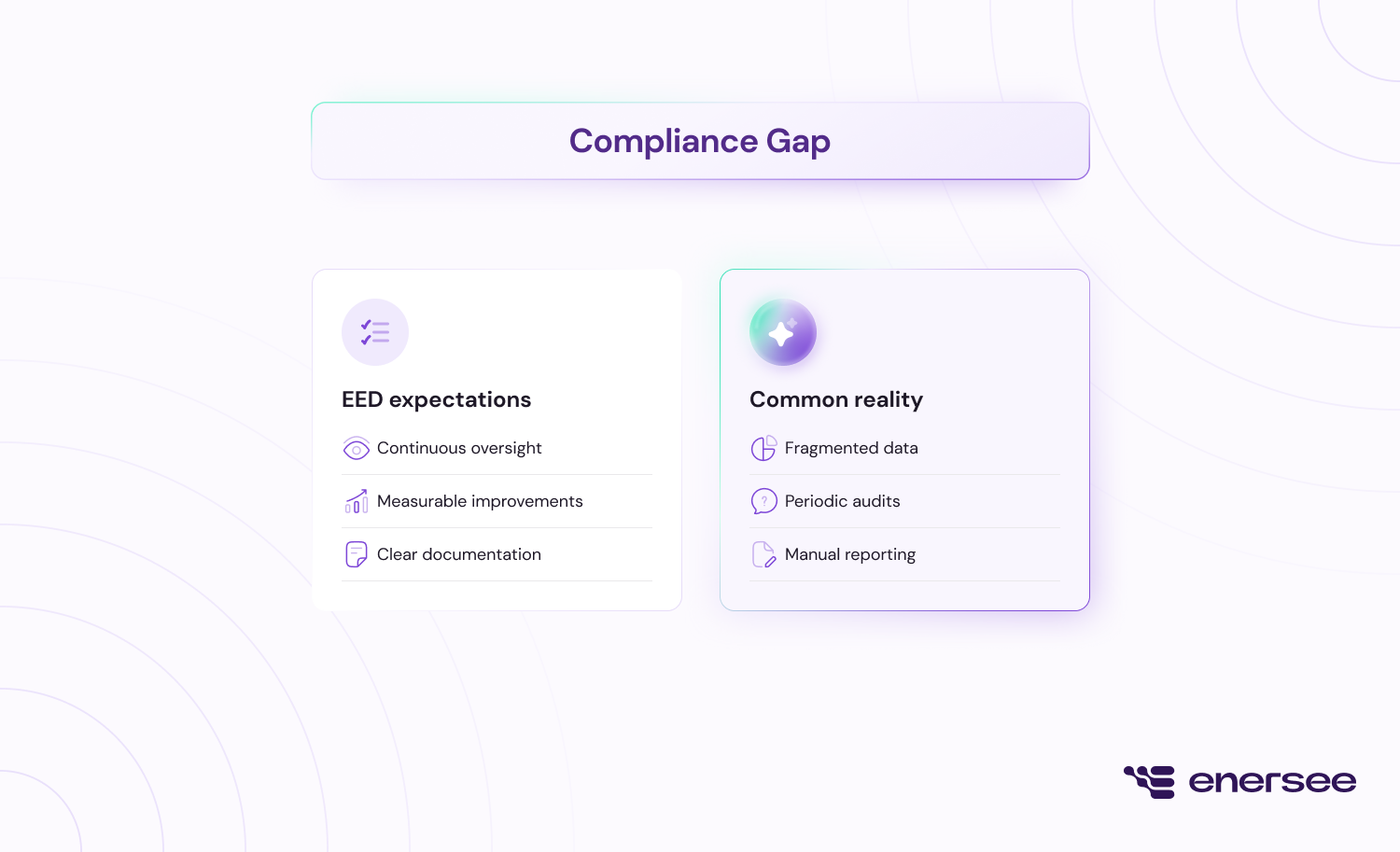
At its core, the EED is all about accountability. Regulators don’t want to just know you’re performing energy assessments. They want to see that you actively manage and improve energy use.
In practice, that means organizations should:
- Maintain a clear overview of energy consumption.
- Identify significant energy uses and inefficiencies.
- Implement improvement measures.
- Track results and savings over time.
- Provide transparent documentation for audits and reporting.
The problem is that many organizations approach these requirements in a fragmented way. They carry out energy audits every few years, collect data manually from multiple sources, and assemble reports after the fact.
By the time they have enough insights into energy use, inefficiencies may have already been there for months or years. And that is precisely why this audit-centric approach becomes difficult to sustain, and where ISO 50001 can help.
What are the benefits of ISO 50001?
A lot of people discuss ISO 50001 only as it relates to European laws. But its global impact is also significant.
The Clean Energy Ministerial estimates that implementing the standard could cumulatively cut energy use by 62 exajoules by 2030, saving over $600 billion in energy costs and avoiding 6,500 mega tonnes of CO2 emissions. That’s equivalent to removing 215 million passenger vehicles from the road.
Long-term, ISO 50001 could influence 60% of the world’s energy use. And the benefits don’t stop there.
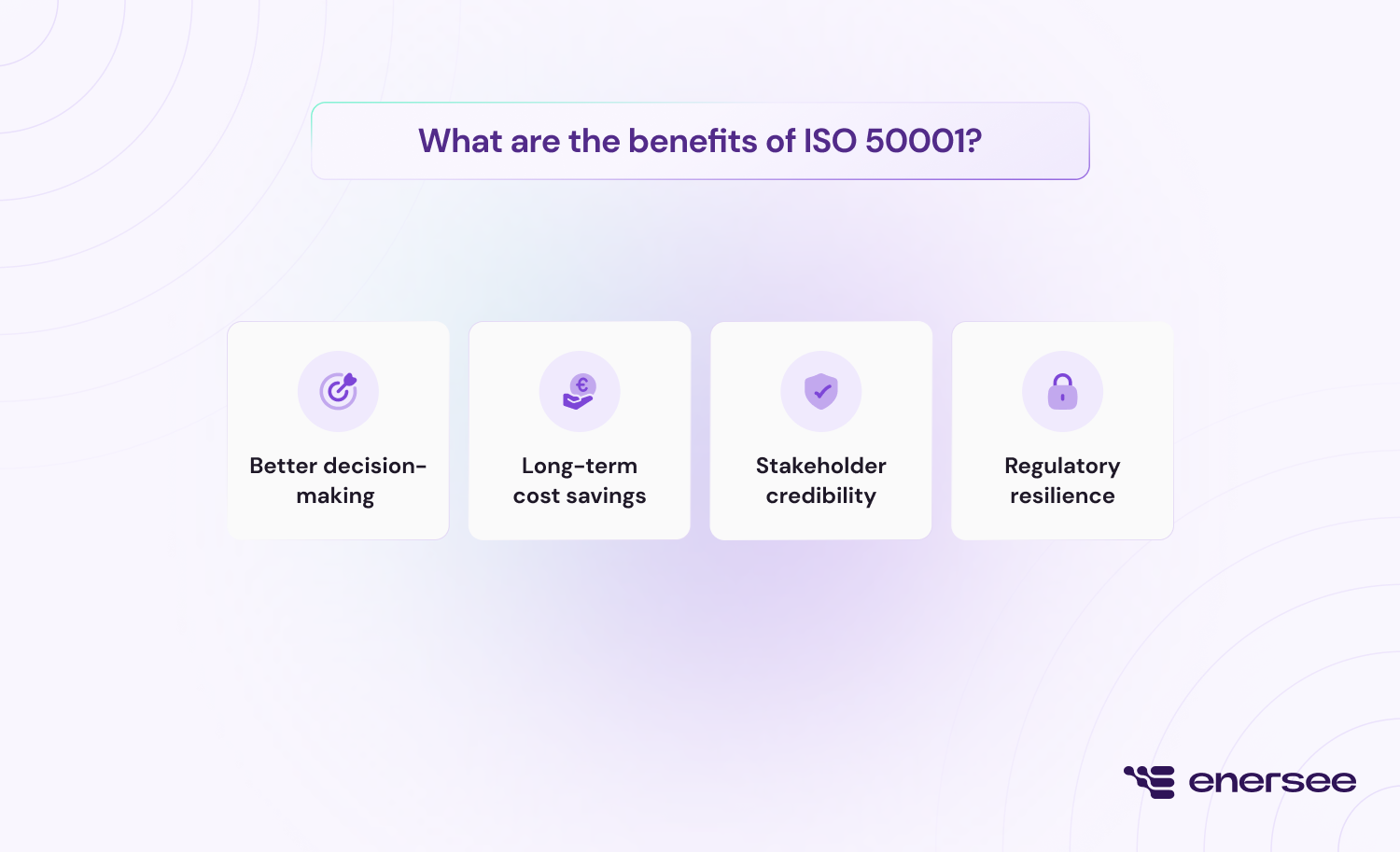
- Better decision-making through structured data. Because organizations have to define energy baselines, performance indicators, and review cycles, they make more evidence-based decisions.
- Cost savings that persist over time. Many energy losses happen because of small, unnoticed issues, like a change of settings, or assets that degrade gradually. A structured EMS helps catch these early, reducing recurring waste.
- Stronger credibility with stakeholders. ISO 50001 shows regulators, investors, and internal leadership that the organization manages energy efficiency systematically. This credibility makes a great difference in the context of ESG reporting, financing, and sustainability commitments.
- Improve regulatory resilience. Because the standard is so comprehensive, your organization will always be ready for energy-related legislation and green initiatives.
Why ISO 50001 is the best road to compliance with EED
The EED outlines obligations, but it doesn’t prescribe a management structure, so organizations can choose how to comply. And that choice can have a major impact on effort and long-term workload.
ISO 50001 offers a practical solution because it:
- Is explicitly recognized within the EED framework.
- Reduces reliance on recurring external audits.
- Creates a reusable structure that scales across sites.
- Encourages continuous compliance rather than last-minute reporting.
For those who manage thousands of buildings or operate across countries, this structured approach is less resource-intensive over time than repeated standalone audits.
How to become ISO 50001 compliant?
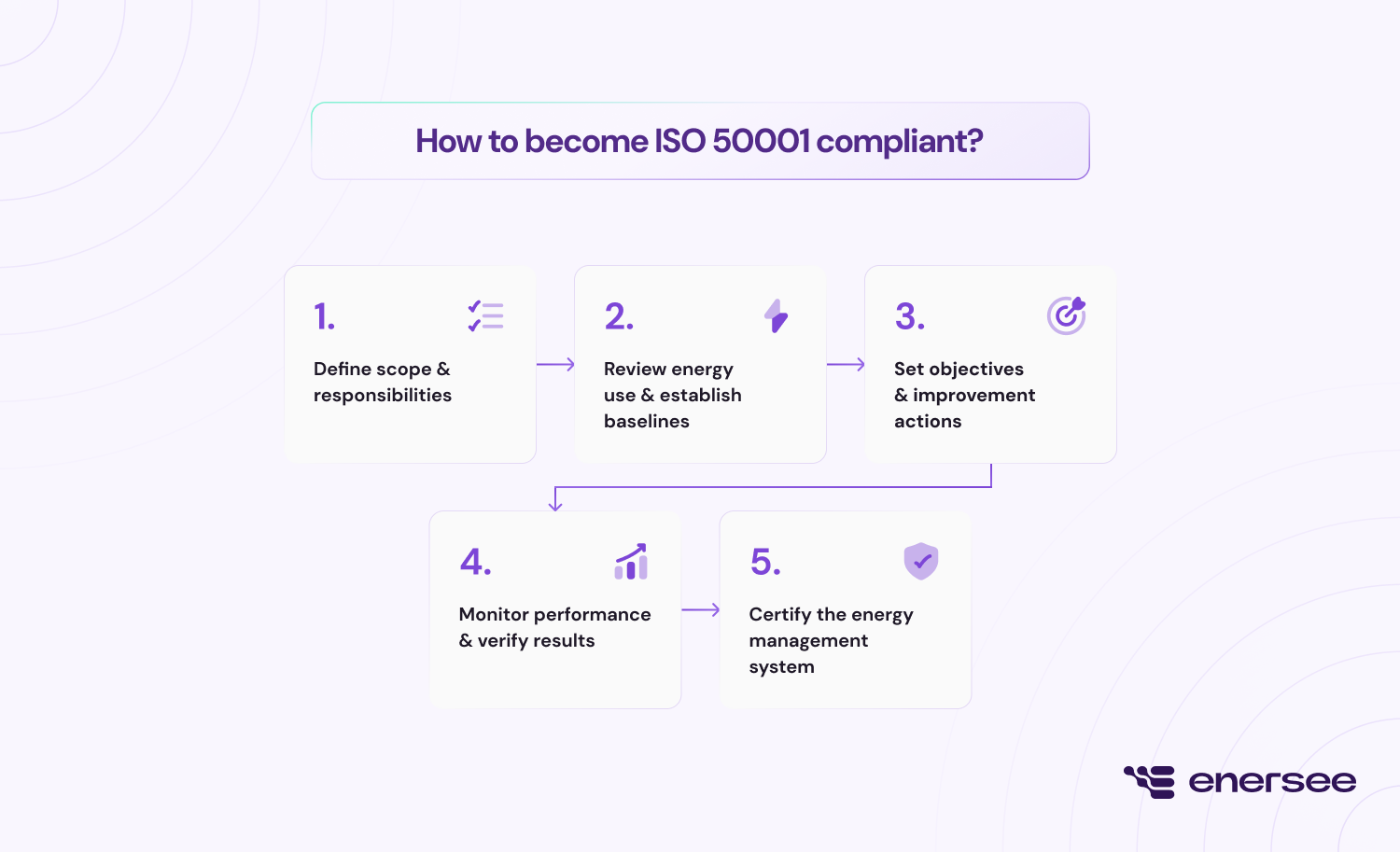
Many believe that compliance with ISO standards is all about documentation. It’s not. If you want to succeed, you’ll need to follow a few practical steps.
1. Define the scope and responsibilities
Before you can do anything else, you need to decide what the energy management system will actually cover. That includes identifying which sites, buildings, processes, and assets fall within scope.
Then, you’ll need to clarify roles and responsibilities across energy, facilities, and management teams. This step may seem easy, but if roles are unclear, the system may pass on paper but might not deliver good results.
2. Build a reliable energy review and baseline
Now that you have the scope, you need to understand how energy is currently used. This review typically includes:
- Identifying significant energy uses (SEUs).
- Establishing baselines and energy performance indicators (EnPIs).
- Highlighting inefficiencies and improvement opportunities
At this stage, data quality is more important than complexity. Incomplete, inconsistent, or manually assembled data can undermine the entire system and make later verification difficult.
3. Set objectives and improvement actions
Based on the previous steps, organizations can define objectives, targets, and action plans. These can include operational adjustments, maintenance actions, or longer-term efficiency projects.
This is where things shift from planning to practice. You need to implement your EMS, document the process and any changes made along the way, so you always have reliable data to analyse.
4. Monitor performance and verify results
Once you have your EMS in place, it’s time to conduct internal audits to make sure everything is working as expected. Monitor energy performance against baselines and targets, investigate deviations, and validate savings.
Without regular monitoring, inefficiencies can persist unnoticed, and improvement measures may underperform without being flagged. Verification is essential both for internal decision-making and for audit readiness.
This process will be continuous to ensure the system remains effective as operations, assets, and energy use grow.
5. Obtain external certification
Is everything working as expected? Then it’s time to pursue external certification. Find an accredited certification body and submit the required documentation. If this step goes smoothly, there will be an on-site assessment, where auditors validate that the implementation is correct.
If they find any non-conformities, you’ll have a designated timeframe to resolve them. Once that’s done, you’ll be officially ISO 50001 certified.
Enersee for ISO 50001 & EED
Implementing ISO 50001 isn’t very hard but maintaining it over time is where many struggle and where the right operational support can make all the difference. Enersee is designed to help organizations translate ISO 50001 from a framework into a working, day-to-day energy management system, while keeping EED requirements in view.
Enersee mirrors the PDCA logic, central to ISO 50001, across daily operations, mid-term projects, and long-term strategy. What does that look like in more practical terms?
- Plan: Automated energy audits and benchmarking provide a clear foundation for defining baselines and improvement objectives.
- Do: Continuous monitoring and anomaly detection surface deviations in real time, allowing teams to act before inefficiencies persist.
- Check: Project tracking, measurement and verification make it easier to confirm whether improvement actions deliver the expected savings.
- Act: Recurring patterns, root causes, and lessons learned feed back into the system, supporting ongoing improvement and higher ambition over time.
Thanks to this loop, organizations can move through PDCA cycles faster and with less manual effort, replacing periodic, spreadsheet-driven reviews with live performance insights.
Enersee also helps meet a key EED goal: demonstrable, ongoing improvements. The platform has a consistent data backbone for baselines, EnPIs, and significant energy uses. That’s why it allows organizations to produce audit-ready evidence at any point in time, not only when audit deadlines approach.
In short, Enersee helps you:
- See performance instantly.
- Detect anomalies in real-time across portfolios.
- Dispatch issues automatically.
- Capture root causes and fixes.
- Validate projects vs. expected savings.
For organizations that want to use ISO 50001 as their main route to EED compliance, Enersee’s support reduces the workload associated with maintaining certification. Instead of treating compliance as a separate task, energy teams can focus on identifying inefficiencies, prioritizing actions, and tracking results.
Written by
Joachim
and