Grocery retail as an industry is notorious for its high consumption of energy. Their buildings consume twice as much energy per square meter as non-food retail outlets. In the UK, major supermarket chains draw roughly 3% of the nation’s electricity. An average supermarket in the US uses about 52.5 kWh of electricity per square foot annually (over 560 kWh/m²).
Where does this huge appetite come from? We can name several culprits, including round-the-clock refrigeration, extensive lighting, HVAC for large open spaces, and other in-store equipment.
At the same time, margins in grocery retail are extremely thin. Rising energy prices, tightening regulations, and increasing pressure from investors and customers mean energy performance now has a direct impact on profitability, compliance, and brand reputation.
There’s one thing we can say for certain: energy management software for grocery retail is a must-have. And it’s not just about having software, but more about having the right one. So, what works, what doesn’t, and how to choose a good EMS? Let’s look at the answers.
The unique challenges of energy management in grocery retail

It’s easy to think, “Energy management is energy management. Why would the sector matter? Why can’t I use the same principle one would in real estate or hospitality?” It’s because grocery retail faces a different set of challenges.
Refrigeration and HVAC
You need to keep food fresh all the time. That’s 100% non-negotiable. But refrigeration is extremely energy-intensive, often accounting for up to 60% of a supermarket’s energy consumption.
A typical store has dozens of refrigerators and freezers running 24/7, from open-display chillers in aisles to large walk-in coolers. When your portfolio includes dozens or hundreds of such buildings, even a minor issue can mean hundreds of thousands of euros wasted.
There’s also another issue: keeping shoppers comfortable in a store full of cold refrigeration units is tricky, to say the least, which is why HVAC in supermarkets can eat up around 15% of energy use.
Long operating hours
Grocery stores often open early and close late (some even 24/7), meaning lights, HVAC, and equipment run for extended periods. Compared to other businesses, supermarkets rarely “rest,” leading to higher overall consumption. Even during closed hours, critical systems like refrigeration and some lighting remain on, so there’s limited downtime to conserve energy.
Diverse equipment
Refrigerators and HVAC aren’t the only tools in grocery retail. Many also have ovens, deli counters, kitchens, coffee machines, lots of plug-in appliances, and extensive lighting on ceilings, shelves, and refrigerated displays. Lighting alone can account for up to 20% of energy use.
Managing all these systems together is not easy. A change in one might affect others. This diversity makes grocery energy management more complicated than in simpler retail formats.
A lot of data, not enough insights
There may be challenges in grocery retail, but having enough data usually isn’t one of them. Most organizations already have millions of data points. The challenge is turning them into insights you can actually use across the entire store network.
Regional compliance
Different countries can have different laws that apply to food sales and grocery stores in general.
Some will apply directly to energy management, like the BACS or EPC-NR in Europe.
Some will affect this indirectly by regulating refrigeration temperatures or operating hours. When you manage buildings in multiple countries or regions, complying with each law can take a lot and requires either a strong tool or a huge team of professionals.
Why traditional EMS tools fail in grocery retail
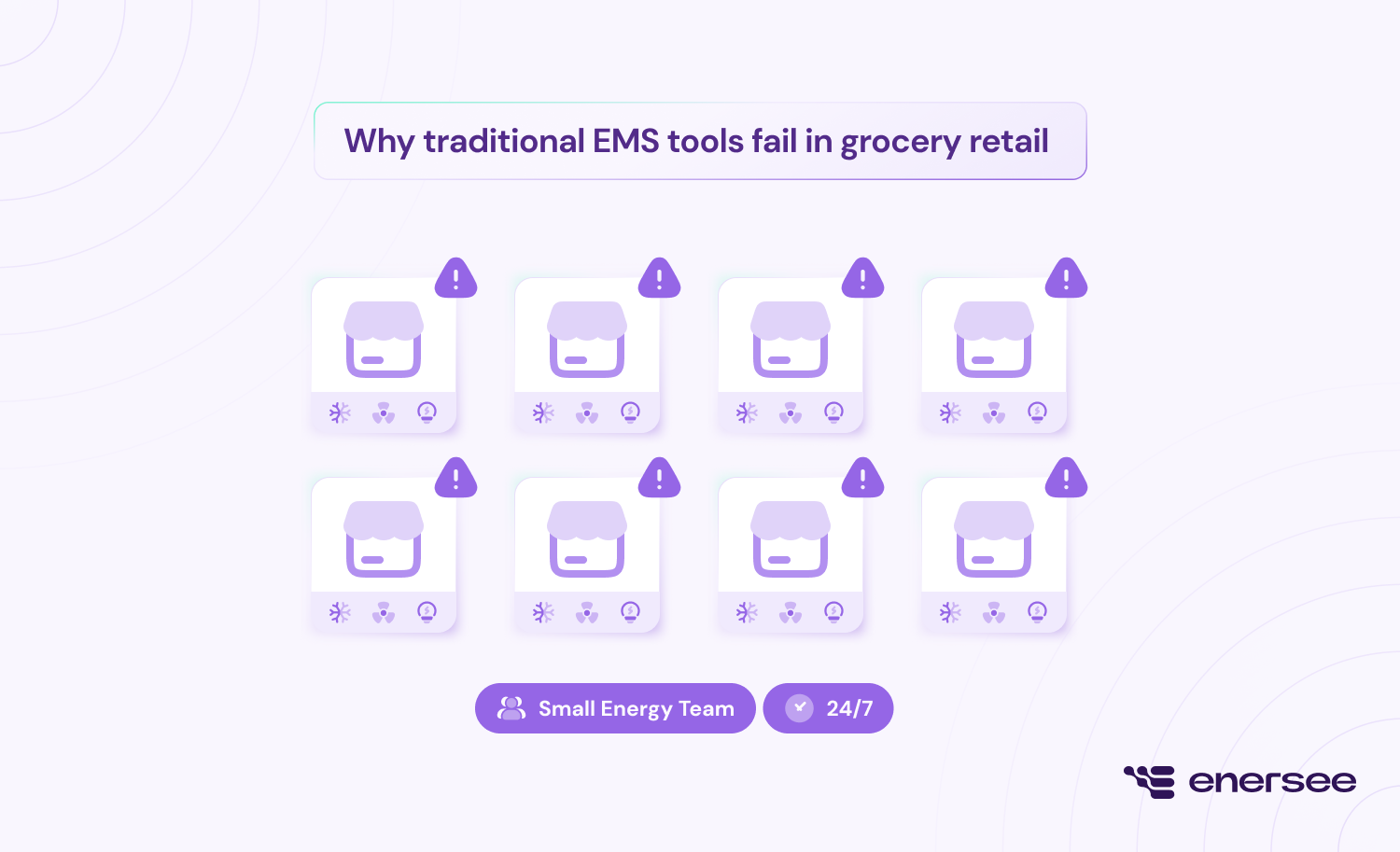
A lot of organizations have some sort of EMS. And yet, the numbers don’t look great. Energy bills comprise roughly 15% of a grocery store’s operating budget.
Along with financial waste, the environmental toll is significant. A typical mid-sized grocery store can produce about 1,383 metric tons of CO₂ per year from energy use alone (that’s equivalent to the annual emissions of over 300 cars).
But why can’t traditional EMS help more? Because they often focus on monitoring individual assets or stores. They may detect anomalies, but typically without enough context to explain why they occur or how urgent they are. In a 24/7 retail environment, that means hundreds of alarms that require manual investigation, store by store.
This approach might work for a small number of locations. But it breaks down completely when applied across large chains. Energy teams are forced to choose between reacting to alerts or trying to identify patterns manually, often with spreadsheets and periodic audits.
What to look for in energy management software for grocery retail
Most grocery retailers already have the raw ingredients for effective energy management, but not the right software to use those ingredients.
Studies show that a good EMS can cut total facility energy use by 10–25% through optimized control. So, how do you choose the right one? The following capabilities are essential.
1. Store and portfolio-level visibility
You need to see both individual stores and the portfolio as a whole. A good EMS will provide a consistent view across locations, making it possible to compare performance, identify outliers, and benchmark stores without drowning in dashboards.
2. Automated detection across refrigeration, HVAC, and lighting
You can’t rely solely on manual audits or periodic reviews in environments that move as quickly as grocery retail does.
Your EMS should analyze consumption patterns around the clock, detecting deviations early across refrigeration, HVAC, and lighting systems. And, even more important, it should clearly signal these deviations, so you can quickly act on them.
3. Prioritization by impact
You can’t always address everything instantly. Software must rank inefficiencies based on financial impact, operational urgency, and potential risk. That way, you can move away from endless alerts to impact-based prioritization, scaling energy oversight without increasing headcount.
4. Compliance and reporting without manual effort
Regulatory requirements such as BACS and EPC-NR, along with sustainability reporting expectations, add significant pressure to grocery retailers.
EMS tools should generate auditable data trails automatically, allowing compliance and ESG reporting to become a by-product of daily operations rather than a separate, manual exercise.
5. Scalability
Store networks are far from static. New locations open, formats change, and systems vary. True scalability means the software reduces manual effort as the portfolio grows, so that the same energy team can manage more stores.
How Enersee can help you turn energy management in grocery retail into an asset
When you use an EMS that “understands” grocery realities, the day-to-day experience of your energy team changes drastically. Instead of reacting to alarms, they have early visibility into emerging issues.
Enersee is your always-on Virtual Energy Manager that connects existing meters and systems to automatically spot inefficiencies. From there, it can quantify their cost and recommend clear action before they land on your bill.
Plus, Enersee prioritizes issues by financial impact and compliance urgency, flags required measures for compliance with the main regulations, and tracks progress and proves ROI.
How does that look like in practice? Enersee already works with a large German grocery retailer and was able to identify 3.6 major anomalies per store, revealing 92.5% more issues than their existing EMS. In their own words, “Enersee helped us pinpoint exactly where we were losing energy — and how to stop it. The speed of detection changed how our energy team works.”
Written by
Anastasiia Andriiuk
and