Most companies try their best to manage energy. They have a lot of meters and data sources. And despite this, so many still fail, wasting energy because of issues that slip through the cracks or are found only after they show up on the bill.
For real estate owners and operators, energy can’t be a simple background operational cost. It must become a central business concern. Rising energy prices, tighter margins, and increasing regulatory pressure mean energy performance now directly affects asset value, tenant satisfaction, and long-term portfolio risk.
Across Europe, building owners are also facing stricter requirements around transparency and efficiency. BACS and EPC-NR aren’t just obligations on paper. Compliance means you now must prove how your building performs, not just what it consumes.
And if that wasn’t enough, more and more investors and tenants expect credible ESG data. In this context, the question isn’t “Should we invest in energy management software?” It’s “What kind of software works for real estate portfolios?”
Many tools promise insight, yet few are designed for the operational reality of managing hundreds of heterogeneous assets at scale.
The unique energy challenges of real estate portfolios

Buildings are the single largest energy consumer in Europe, accounting for about 40% of EU energy use and 36% of CO2 emissions. Yet roughly 75% of the EU building stock is energy-inefficient, meaning much of the energy used effectively goes to waste.
In commercial buildings worldwide, inefficiencies are so prevalent that around 30% of the energy is simply wasted even though most organizations already have an EMS. They have all the data at hand. So, where do they fail exactly? How do we get from having energy meters and data sources to still wasting so much energy? There are several challenges that hinder progress.
1. Data silos & reactive monitoring
Every building runs on a mix of systems: BMS, IoT, submeters, utility feeds, solar inverters, and each one speaks a different language. Integrating all of that is slow, messy, and often locked behind vendors. The result? Far too many data silos and blind spots.
This is especially problematic in large portfolios or public-sector agencies managing many sites, where comparing performance and benchmarking is difficult without integrated data.
2. Legacy equipment & technical barriers
Traditional EMS tools are good until you realize you still need to rely on giant Excel spreadsheets and manual, periodic audits.
Replacing or retrofitting them can cut consumption dramatically (e.g. new HVAC equipment can use 30–50% less energy than 20-year-old units). Sadly, these upgrades require investment and downtime, something not every organization has.
3. Organizational & behavioural challenges
One issue in commercial real estate is the split incentive problem: building owners often pay for efficiency upgrades, while tenants reap the benefit of lower bills (or vice versa in triple-net leases). This misalignment can stall investment in energy-saving measures.
Occupant comfort vs efficiency can be another peculiar challenge. Facility managers must balance keeping occupants happy with temperature, lighting and air quality, while avoiding energy waste. Complaints about buildings being “too hot/too cold” often lead to constant HVAC adjustments or overrides that can waste energy if not properly managed.
4. Regulatory & compliance pressure
BACS, EPC-NR and similar regulations have a heavy impact on how you manage energy in your buildings. Building owners now face legal requirements to improve energy performance on set timelines.
Non-compliance can lead to fines, loss of occupancy permits, or other penalties. Not to mention reputational damage for public institutions that don’t comply.
Beyond government mandates, there are market pressures such as investor and tenant expectations.
Sustainability reporting frameworks require detailed energy and carbon disclosures. Without the proper tools in place, compliance with so many regulations can quickly go from opportunity to complete chaos.
Why traditional energy management software fails in real estate

You have your energy meters, data sources, and other types of EMS. And yet, something isn’t working.
One common culprit is alert overload. Traditional EMS tools generate large volumes of alarms with little to no context, leaving you to manually investigate every single one. When you’re managing hundreds of buildings, that’s not just unrealistic. It’s downright impossible.
Speaking of hundreds of buildings, scalability is another challenge with traditional EMS. These tools work just fine for a handful of buildings. But when you have more? Everything starts to fall apart.
What to look for in energy management software for real estate
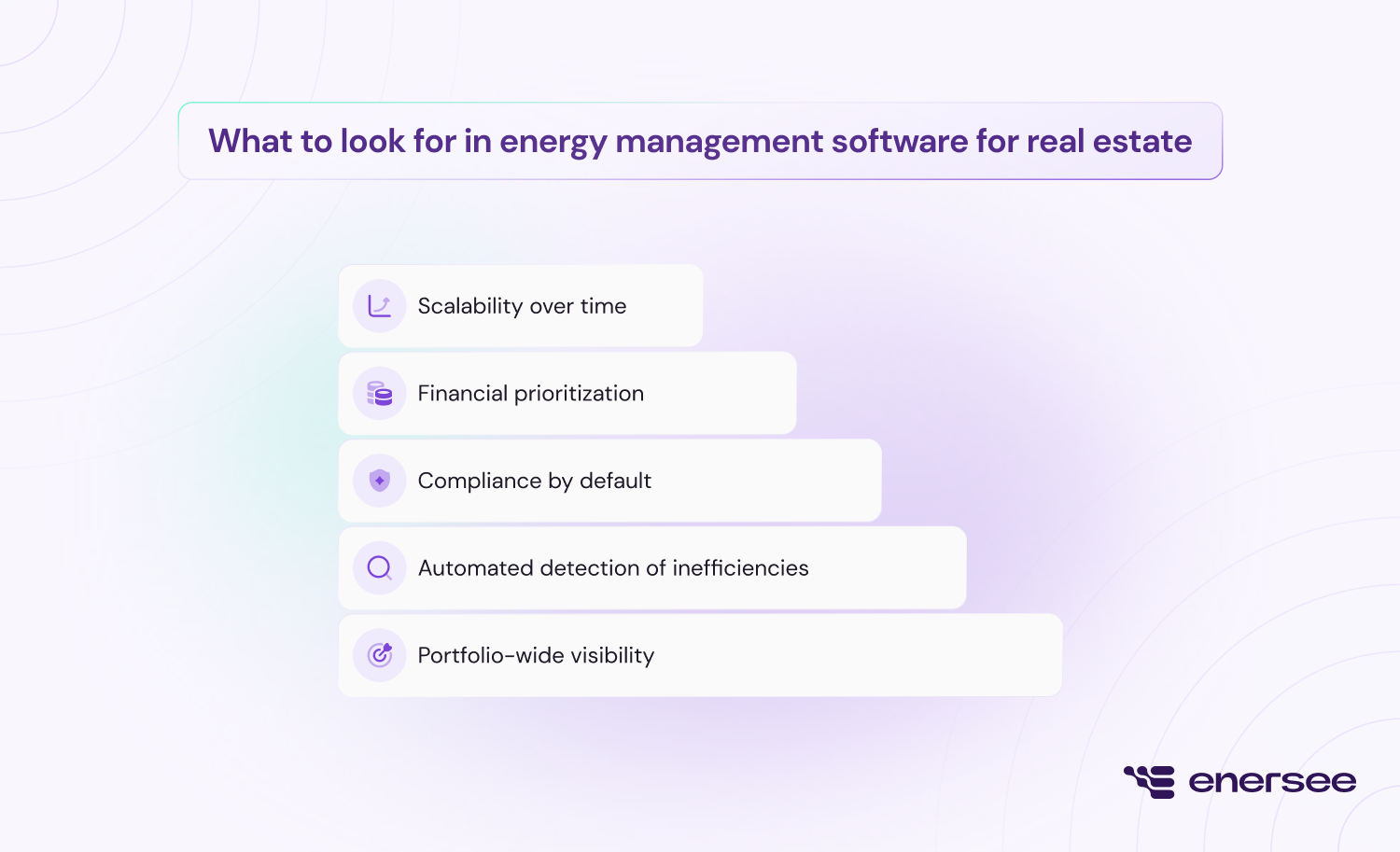
You understand what and why it doesn’t work, but how to choose the right energy management software in real estate? The answer goes beyond a few generic features.
1. Portfolio-wide visibility
You can’t look at the data from one building and expect all the others to work exactly the same. That’s why in real estate, you need a consistent view across all assets, no matter the building type, tenant mix, or technical maturity.
In practice, that means connecting directly to existing metering and building systems and standardizing performance indicators across the portfolio without forcing a uniform infrastructure.
2. Automated detection of inefficiencies
When you manage hundreds of buildings, relying on periodic audits or manual reviews is inefficient, to say the least.
A good energy management software will continuously analyze consumption patterns to detect deviations early across HVAC, lighting, refrigerators, and other systems. Then, it will translate these deviations into signals that you can act on, not an infinite list of alerts.
3. Compliance by default
You can’t treat compliance as a separate reporting exercise anymore. For real estate portfolios facing obligations such as BACS, this means automated audits, standardized reporting, and auditable data trails that can be easily exported.
4. Financial considerations
Energy management software must rank anomalies and improvement opportunities based on financial impact, operational urgency, and compliance risk, so that your team can focus their limited resources where they’ll deliver the highest ROI.
Going from technical alerts to financially grounded prioritization is a must for scaling energy oversight without increasing headcount.
5. Scalability
Your portfolio isn’t going to be static, so why should the EMS? True scalability separates portfolio-ready platforms from traditional tools. As you manage more and more buildings, the software should reduce manual effort, not multiply it.
How Enersee can help you turn energy management in real estate into an asset
In real estate, you can’t look at energy management as a nice-to-have operational tool anymore. You need to treat it as a critical component of asset performance, compliance, and risk management.
Generic traditional systems can offer visibility. But they’ll rarely deliver the clarity and scalability required by such portfolios. That’s why the best strategy is to focus on software built for complexity, one that can turn energy from an uncontrolled cost into an asset for long-term value.
Enersee connects directly to your metering and BMS systems to give you portfolio-wide energy intelligence instantly. It doesn’t matter if anomalies are happening in a warehouse, cold storage, office, or somewhere else entirely. Enersee can detect them all in real time while also benchmarking buildings and tenants against performance baselines.
And if you’re worried about compliance, you’ll get all the data you need for ESG reporting and compliance documentation. Don’t take our word for it. One of our clients explains it best: “Enersee gives us full visibility — where we’re losing energy, where to invest, and where we’re already winning.”
Written by
Anastasiia Andriiuk
and