Energy management is almost never an easy conversation. But in healthcare and retirement groups, it takes an entirely different turn. Here, energy is much more than an operational line item, nor is it all about how much you spend. Patient safety, comfort, quality of care, and regulatory compliance, all come into play.
Hospitals and retirement homes operate some of the most energy-intensive buildings out there. They run 24/7, rely on complex HVAC and ventilation systems, and have to maintain strict indoor air quality and temperature standards.
And, if that wasn’t challenging enough, they also face tighter sustainability regulations than real estate, for instance, and chronic staff shortages.
In this context, the energy management software in hospitals and retirement groups becomes an essential piece of the puzzle. And the true challenge isn’t just how to manage energy, but how to do so without compromising care, compliance, or the already overstretched teams.
The unique energy challenges of hospitals and retirement groups

Healthcare buildings consume a lot more energy than those in real estate or grocery retail. And that’s not an overstatement. European hospitals typically consume roughly 230–330 kWh per square meter (kWh/m²) annually.
Retirement homes don’t have it easier. A European survey of 100 care homes found an average of about 252 kWh/m² per year. Older UK benchmarks likewise showed “typical” nursing homes consuming on the order of 300–500 kWh/m² yearly in combined heat and electricity.
You’re probably wondering why that happens. Sure, they run 24/7, but so do many office buildings and grocery stores. The answer includes more sensitive equipment and stricter requirements and other unique challenges for hospitals and retirement groups.
1. Non-negotiable comfort and air quality
HVAC is a huge energy consumer in hospitals. In the UK, for instance, about 44% of energy goes to HVAC systems.
In U.S. healthcare facilities, space heating alone can be ~29% of energy use, with ventilation fans ~12% and cooling ~11%. Put together, HVAC processes easily exceed 50% of consumption. Ventilation requirements are particularly energy intensive.
Retirement homes aren’t as clinically intensive, but they still need stable indoor conditions all the time. The core challenge: comfort and efficiency are inseparable but rarely managed together.
2. Complex, aging building systems
Sadly, many hospitals and care facilities operate in buildings that are decades old. In theory, there’s nothing exactly wrong with that. In practice, that means HVAC systems, boilers, chillers, and other equipment may not be as effective as they should.
This creates two problems:
- Energy inefficiencies remain hidden across systems.
- Facility teams spend excessive time diagnosing issues manually.
Traditional EMS tools struggle to handle this heterogeneity at scale.
3. Audit and compliance pressure without extra staff
Regulatory obligations don’t skip over hospitals. If anything, it’s the opposite. BACS, EPC-NR, ISO 50001, and broader ESG reporting requirements, all apply. In some cases, they even go deeper.
Many countries are essentially outlawing poorly performing facilities: the Netherlands now prohibits using office buildings that are below EPC class C as of 2023. And yet, energy and facility teams are often understaffed.
In many places, energy audits remain periodic, manual, and backward-looking. By the time you spot an issue, it’s already been there for weeks or even months.
4. Continuous operation, zero downtime tolerance
One recent industry analysis noted that hospitals spend roughly €2,200–€3,900 per bed each year on energy, which amounts to about 2.1% to 10% of operating expenses (depending on the facility’s size and efficiency). That amounts to a double-digit percentage of EBITDA.
The problem is, as much as you’d like to sometimes give the facility some downtime, that’s impossible. Most equipment must run continuously, even during low-occupancy periods. This takes traditional energy-saving tactics out of the equation and makes early anomaly detection essential.
Why traditional EMS tools fall short in healthcare settings
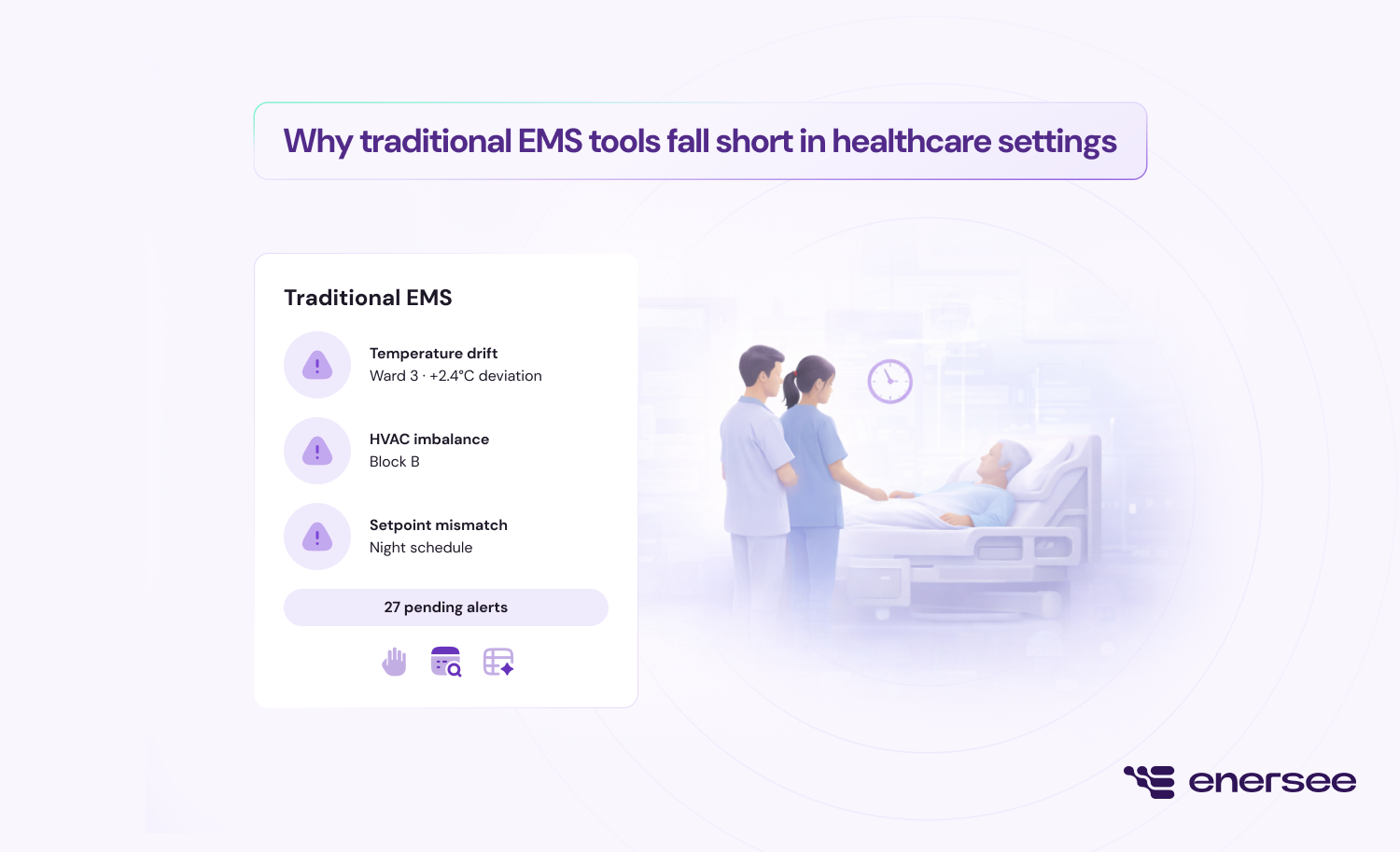
Most hospitals and retirement groups have some type of energy monitoring in place. And yet, inefficiencies aren’t going anywhere. In fact, studies consistently show that these buildings waste 20-30% of energy through operational inefficiencies. Yes, even when they have monitoring systems.
That’s because traditional energy management systems tend to:
- Generate large volumes of technical alerts without context.
- Focus on individual assets rather than portfolio-wide patterns.
- Require significant manual interpretation by specialists.
In a clinical environment, this leads to two bad outcomes:
- Alerts get ignored because teams don’t have time to investigate them.
- When teams do address problems, they look only at the most obvious ones. Systemic inefficiencies remain untouched.
At scale, it’s an approach that will never work because it actively limits an organization’s ability to control energy risk across its portfolio.
What to look for in energy management software for hospitals and retirement groups

Choosing energy management software in healthcare requires a different lens than in commercial real estate or retail.
1. Continuous, automated audits
If you work with systems that run 24/7, periodic audits aren’t enough. Effective software needs to analyse energy behaviour continuously so that you can catch deviations before they affect comfort, safety, or compliance.
2. Comfort-aware energy intelligence
Energy management software must understand the trade-off between consumption and comfort. In simple terms, that means correlating energy data with indoor conditions, or operational context.
Without this, you’ll have to choose between efficiency and resident/patient comfort, a choice that has no place in healthcare.
3. Portfolio-level visibility across diverse sites
Large healthcare groups manage dozens or hundreds of facilities, each with different profiles. Software must standardize performance across this diversity, allowing benchmarking and prioritization without uniform infrastructure upgrades.
4. Compliance by default
A huge mistake we often witness is treating compliance as a separate project. The right energy management software automatically builds auditable data trails, flags regulatory risk, and supports reporting for frameworks like BACS and EPC-NR.
5. Prioritization that reflects real-world constraints
You’re never going to fix everything immediately. Your EMS should rank problems by financial impact, compliance risk, and urgency, so that you can focus on what matters most.
How Enersee can help you turn energy management in hospitals and retirement groups into an asset
An EMS that operates with the realities of healthcare facilities in mind improves things drastically. Enersee, a 24/7 Virtual Energy Manager, gives healthcare operators a single, intelligent platform to manage energy performance across all sites automatically.
Because it works around the clock, it detects inefficiencies across heating, cooling, and ventilation systems long before they pose problems to your facilities.
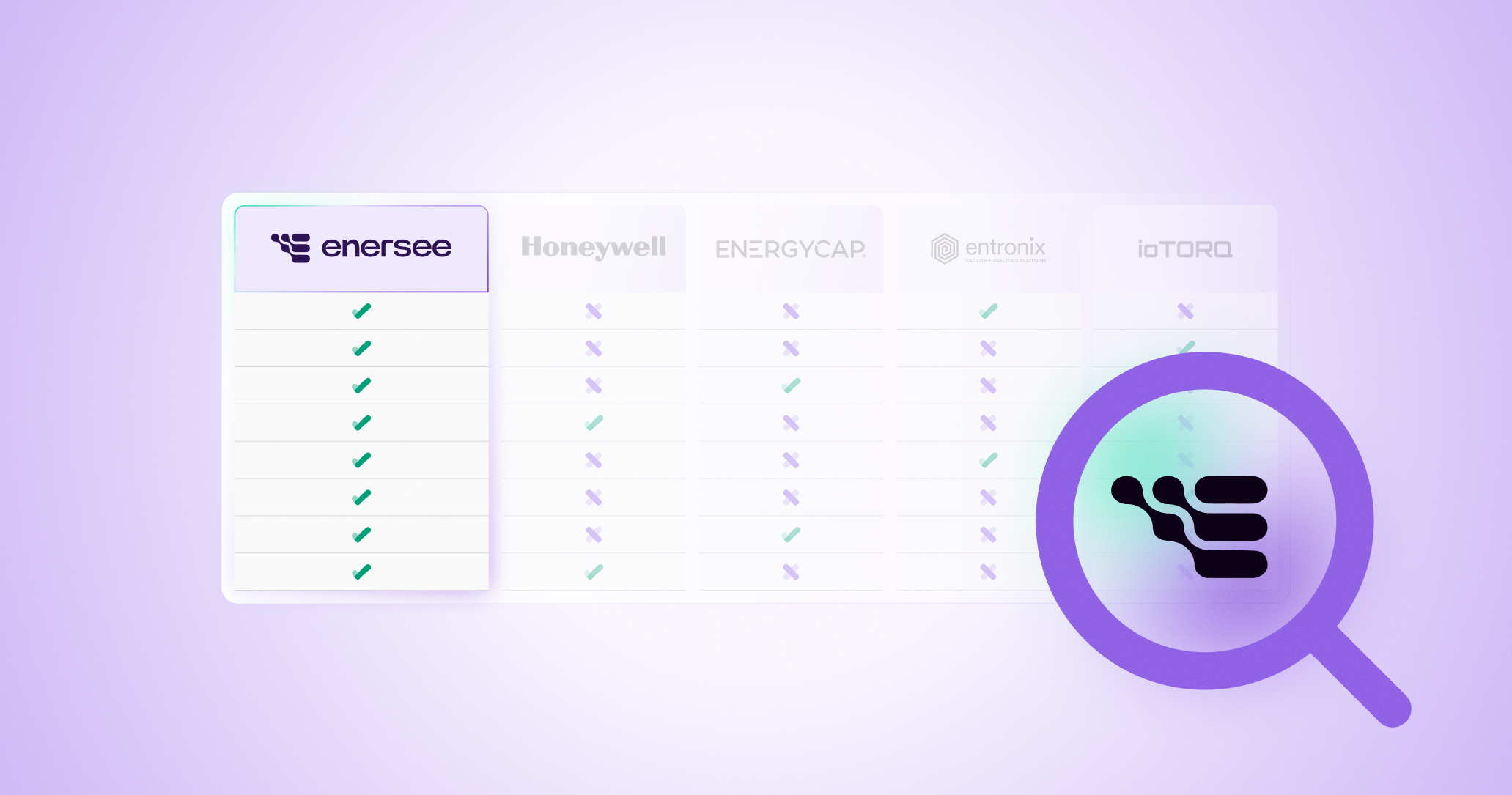
And unlike other EMS, Enersee doesn’t overload you with alerts, only to let you do all the analysis by yourself. Instead, it provides real-time insights into comfort vs. consumption trade-offs, a must-have in hospitals and retirement groups.
Plus, it automates energy audits and helps with reporting for BACS, EPC-NR, and other regulations.
How does all that look like in practice? Korian (Clariane Group) manages hundreds of care facilities across Europe. Enersee helped them gain continuous visibility into building performance and reduced their audit workload so that staff could focus on patient care, not spreadsheets.
“What I like about Enersee is how easy it is to use. It gives a clear overview, helps us spot and correct data errors quickly, and feels like an extra pair of eyes keeping our data in check.”
Written by
Anastasiia Andriiuk
and