If you’ve already looked into ISO 50001, you probably understand what it takes to set up an energy management system. You know about the Plan-Do-Check-Act cycle, the baselines, the energy performance indicators. Maybe you’ve even started the process.
But there’s a difference between understanding the framework and actually running it day after day, across dozens or hundreds of sites. That’s where most organizations hit a wall.
Software is the answer. Sadly, though, you can't use just any software. There's a large number of options on the market, tools that claim to support ISO 50001, but aren't actually built for the reality of maintaining certification over time. "Try one and see where it takes you" will more often than not mean a lot more work on your plate. Along with a huge risk for non-compliance.
So how do you evaluate your options? What should ISO 50001 energy management software actually do? And what separates a platform that helps you get certified from one that helps you stay certified?
Why spreadsheets and manual processes fall short
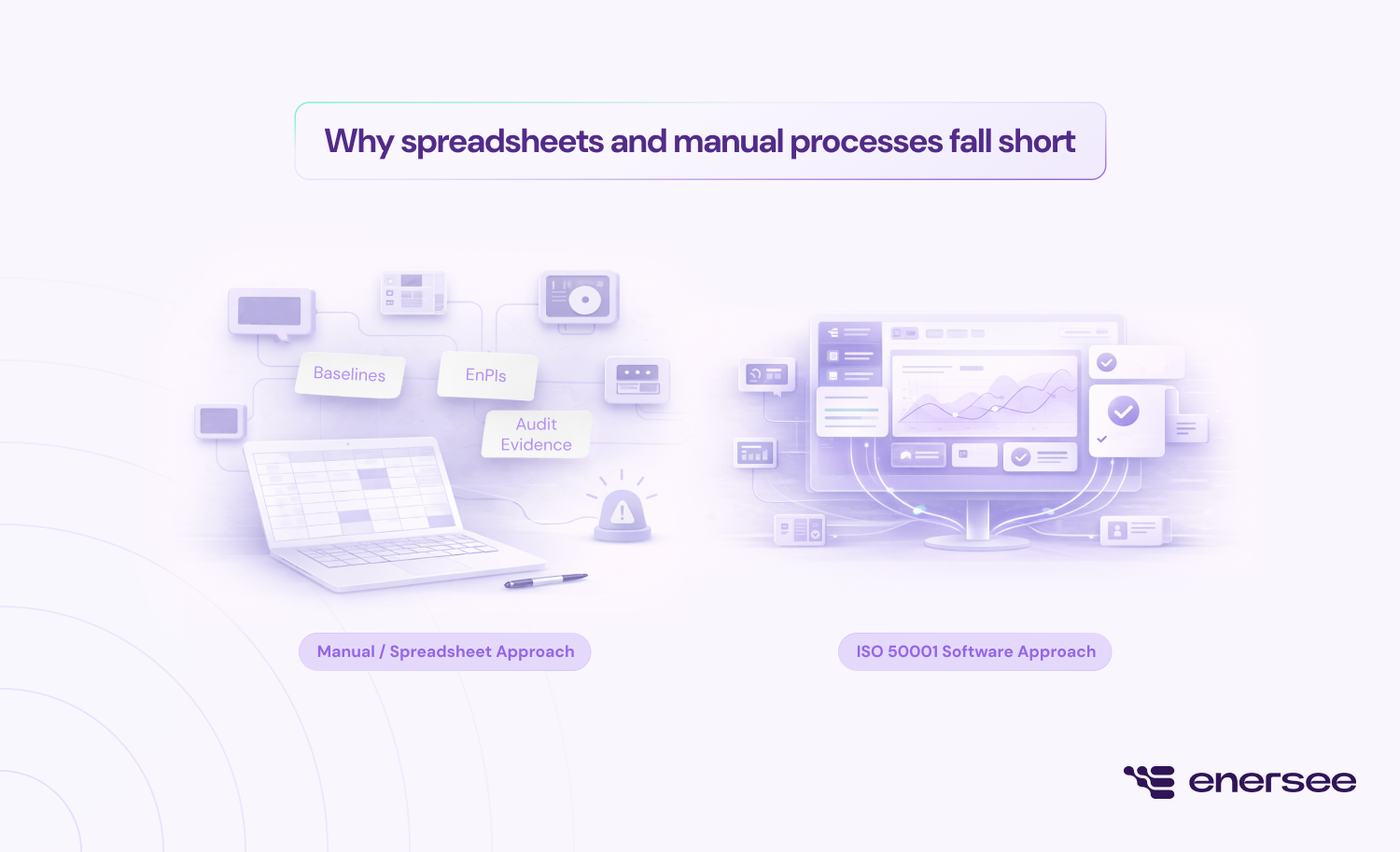
Before we talk about criteria, we need to understand why organizations need a dedicated ISO 50001 tool in the first place.
This standard is a living system. You need to figure out what uses the most energy, establish baselines and EnPIs, monitor performance against various targets, investigate deviations, and document everything so that it's audit-ready whenever needed.
There are a lot of variables. And many organizations start with spreadsheets. There's no reason why they shouldn't work at first sight. But problems appear rather quickly. Data is everywhere across building management systems, meters, utility bills, and IoT sensors. Baselines that you build in Excel are hard, if not impossible, to maintain or validate over time.
And when audit season finally arrives, teams rush to gather evidence that they should already have. There's a real gap, a day-to-day execution and evidence burden. ISO 50001 compliance software can close it by centralizing data, automating monitoring, and creating the feedback loops the standard demands.
What to look for in ISO 50001 software
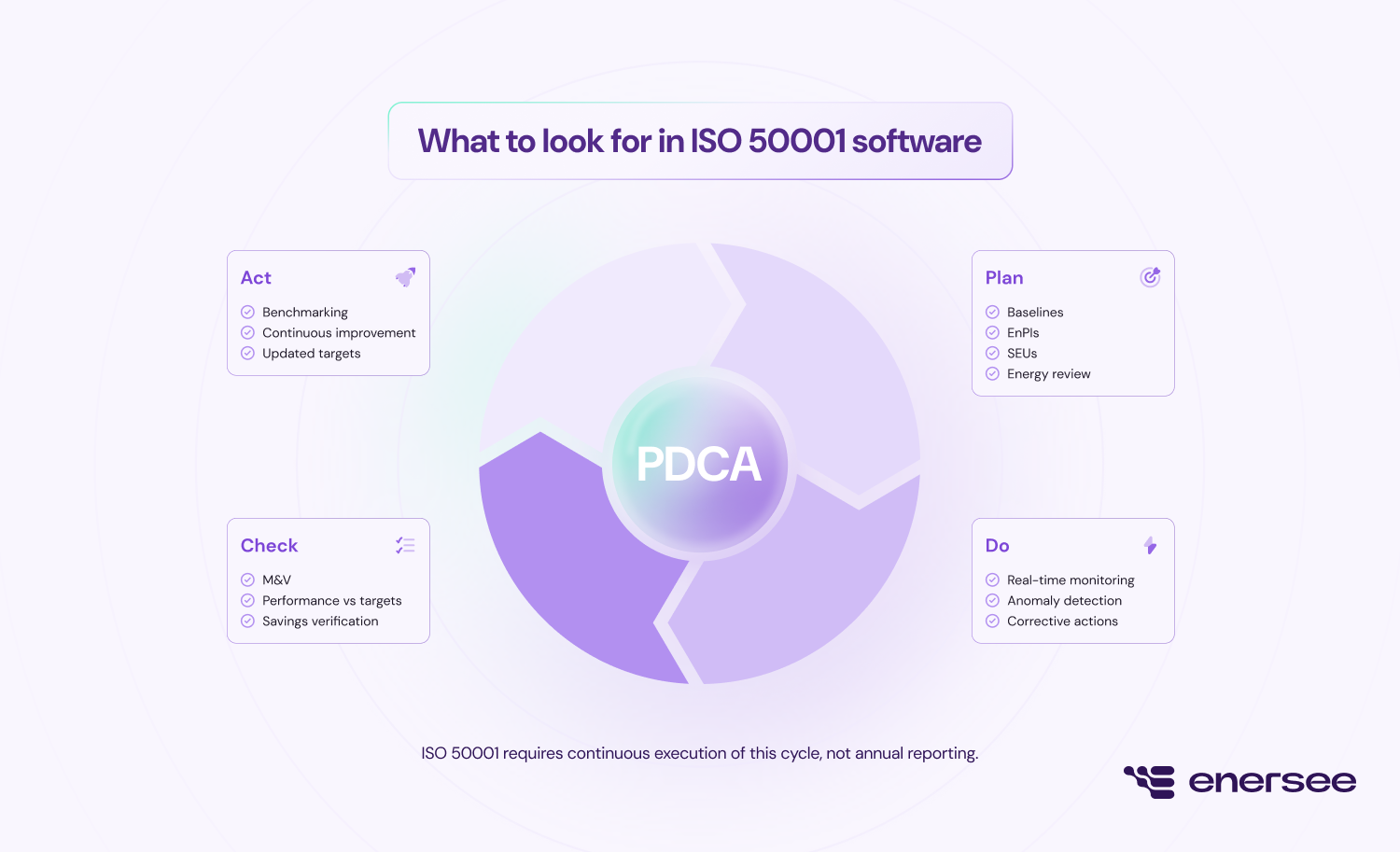
Not every energy management platform is built with ISO 50001 in mind. Some focus on billing, others on carbon reporting. When you’re evaluating ISO 50001 compliance software specifically, there are several capabilities that matter most.
1. A solid data backbone
Everything in ISO 50001 starts with reliable data. Your software should be able to connect to multiple data sources such as smart meters, BMS, AMR systems, IoT devices, even utility bills, and consolidate them into one coherent picture.
Without a single source of truth, every downstream activity (baselines, EnPIs, audits) is built on shaky ground.
Look for platforms that handle data quality proactively: flagging gaps, detecting inconsistencies, and making it easy to model your portfolio of sites, buildings, and meters.
2. Baseline and EnPI management
Establishing energy baselines and performance indicators is fundamental to ISO 50001 but maintaining them is where the real challenge lies. Baselines need to be adjusted when conditions change: new equipment, different occupancy patterns, weather variations.
Good ISO 50001 software should let you define, track, and update baselines with minimal manual effort. It should also make it straightforward to visualize performance against those baselines, so you can see at a glance whether you’re improving or drifting.
3. Continuous monitoring and anomaly detection
The PDCA cycle at the heart of ISO 50001 isn’t something you run once a year. It’s continuous. That means you need software that monitors energy performance in real time, or close to it, and surfaces deviations before they persist for weeks or months.
Anomaly detection is particularly important here. Think about what typically happens without it: an HVAC schedule changes, a setpoint drifts, or a piece of equipment degrades gradually. Without automated alerts, these issues only show up in monthly bills, long after the waste has occurred. The right software catches them within days, assigns them to the right person, and tracks resolution.
4. Measurement and verification (M&V)
Implementing improvement projects is only half the battle. ISO 50001 requires you to verify that those projects actually delivered the expected savings. That’s measurement and verification.
Your software should support project tracking with built-in M&V capabilities. That means comparing actual performance against projected savings, flagging underperforming measures early, and producing the evidence auditors need to confirm your results. Without this, you end up with a list of completed projects but no reliable way to prove their impact.
5. Audit readiness and documentation
One of the biggest advantages of ISO 50001 software is eliminating the last-minute scramble before certification audits. The right platform should generate audit-ready evidence as a natural byproduct of daily operations, not as a separate reporting exercise.
That includes documentation of your energy review process, records of corrective actions, evidence of management reviews, and a clear trail showing how deviations were identified, investigated, and resolved. If you’re producing this documentation continuously, audit preparation becomes a matter of hours, not weeks.
6. Scalability across sites
If your organization manages a handful of buildings, almost any approach can work. But if you’re operating across dozens or hundreds of sites, possibly in different countries, scalability is non-negotiable.
Look for software that lets you apply consistent processes and benchmarks across your entire portfolio. Centralized dashboards, cross-site anomaly detection, and standardized workflows make it possible for small energy teams to manage large portfolios without proportionally growing headcount.
Questions to ask when evaluating vendors
Beyond feature checklists, there are practical questions that can help you distinguish between platforms that look good in a demo and those that work well in practice.
- Does the platform mirror the PDCA cycle, or does it only cover parts of it? A tool that handles planning but not verification leaves you with gaps.
- How does it handle data integration? Can it connect to your existing metering infrastructure, or does it require a separate data pipeline?
- What happens when data is poor or fragmented? Some platforms assume clean data from day one. Others help you build toward data maturity over time.
- Can you produce audit-ready evidence at any point, or only when you manually generate reports?
- How much manual effort is needed to maintain the system once it’s set up? The initial implementation is one thing; ongoing maintenance is what determines long-term success.
These questions matter because the real test of ISO 50001 software isn’t the first audit. It’s the third, and the fifth, when the novelty has worn off and the system needs to keep running on its own momentum.
The difference between getting certified and staying certified
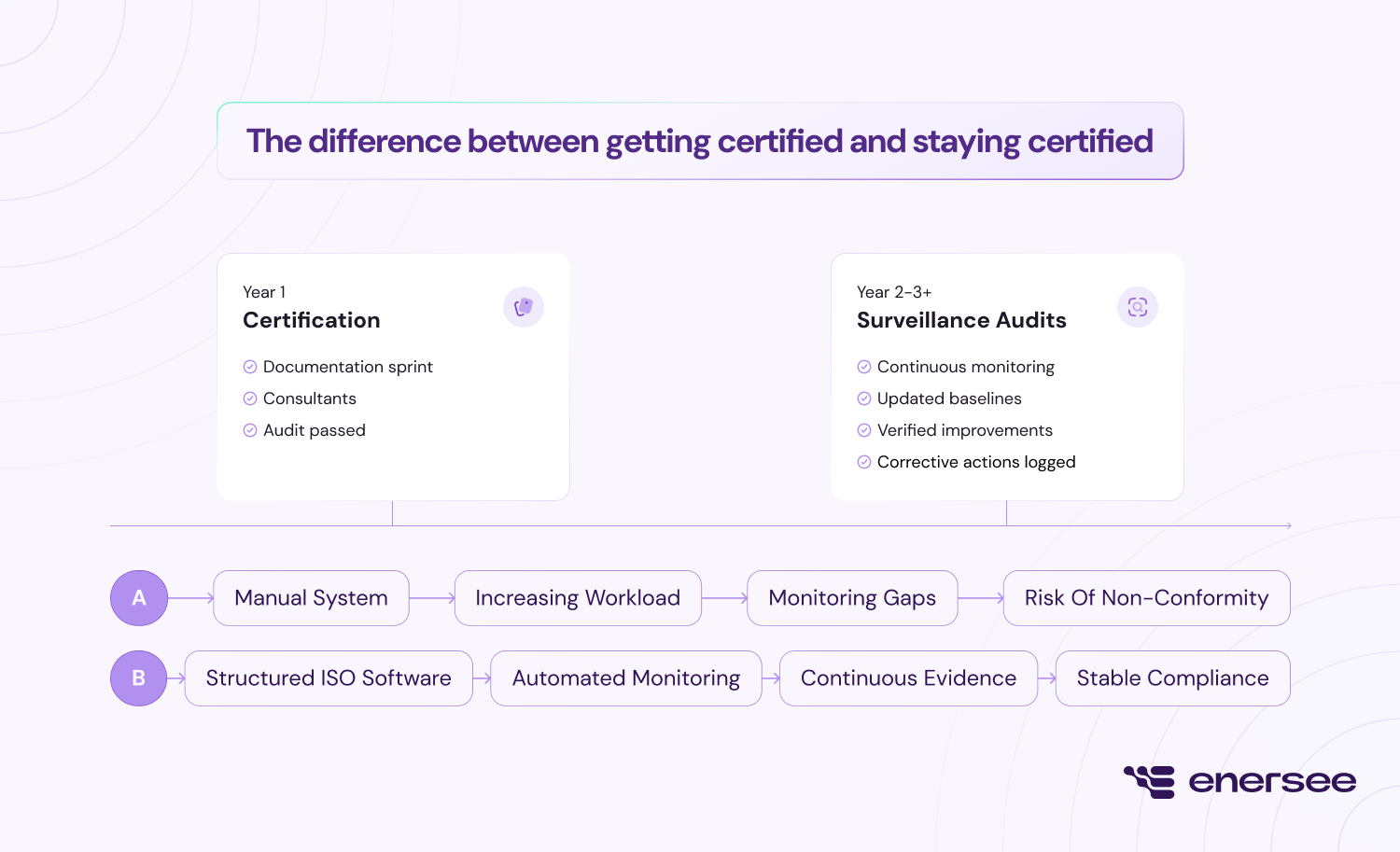
This is a distinction that doesn’t get enough attention. Many organizations achieve ISO 50001 certification with a burst of effort: consultants, documentation sprints, manual data assembly. But maintaining that certification year after year is a different challenge entirely.
Certification bodies conduct annual surveillance audits. They look for evidence of continuous improvement, not just a system that was set up correctly once. They want to see that non-conformities are identified and resolved, that baselines are kept current, and that the organization is genuinely using the EMS to drive decisions.
This is where the right software makes the biggest difference. A platform designed for ongoing operations, one that provides automated anomaly detection, guided workflows for issue resolution, and continuous M&V, takes ISO 50001 from a periodic compliance exercise to a working management system.
How Enersee approaches ISO 50001 compliance
Enersee is designed around exactly this philosophy: that ISO 50001 isn’t a documentation exercise, but a practical system for knowing where your energy goes, improving it systematically, and proving it.
The platform mirrors the PDCA logic across three layers of energy management. Enersee helps you handle day-to-day tracking and anomaly detection, manage mid-term improvement initiatives with built-in M&V, and it supports long-term planning and portfolio-level decision-making.
In practice, that means automated energy audits and benchmarking provide a foundation for the Plan phase. Continuous monitoring and real-time anomaly detection power the Do phase, surfacing deviations before they persist.
Project tracking and savings verification cover the Check phase. And recurring pattern analysis and lessons learned feed back into the Act phase.
For organizations managing large portfolios, Enersee’s centralized data backbone for baselines, EnPIs, and significant energy uses means audit-ready evidence is available at any point. A team of two or three people can manage what previously required significantly more resources because the platform handles the operational burden of maintaining the management system.
Whether you’re implementing ISO 50001 for the first time or looking to strengthen an existing certification, the goal is the same: moving from periodic compliance efforts to a system that runs continuously with less manual work. That’s ultimately what good ISO 50001 software should deliver.
Written by
Anastasiia Andriiuk
and